
Cervical spine symptoms are any signals produced by the seven vertebrae, discs, joints, nerves and muscles of your neck, and they rarely stay in the neck. The same segment that feels stiff when you shoulder-check can send burning pain into your thumb, numbness into two fingers, or a vague heaviness into your arm that is hard to describe to anyone. Most of these symptoms come from irritated joints and muscles and settle with the right loading. A small number come from a compressed nerve root, and a smaller number again from pressure on the spinal cord itself, which is the group worth recognising early. This page sorts the symptoms by which structure is producing them, and tells you how quickly each group needs attention.
What counts as a cervical spine symptom
Your neck is a stack of seven vertebrae carrying a head that weighs roughly as much as a bowling ball, threaded through with the spinal cord and eight pairs of nerve roots that supply your shoulders, arms and hands. Anything arising from that structure counts, which is why the list is wider than most people expect: pain, stiffness, grinding, headaches at the base of the skull, dizziness on turning, pins and needles, weakness, clumsiness.
Here is what does not count, and these get confused with the neck constantly:
- Pain that only appears when you lift your arm overhead, with no neck symptoms at all. That is usually the rotator cuff.
- Numbness in the thumb, index and middle finger that wakes you at night and improves when you shake your hand. That pattern points to the wrist, not the neck.
- Pain in the jaw and temple that worsens with chewing. That is a jaw joint problem.
- Chest tightness or left arm heaviness brought on by exertion and relieved by rest. That is a cardiac pattern and it needs emergency assessment, not a physiotherapist.
Why a neck problem shows up in your hand
Nerve roots leave the spine between the vertebrae and travel down the arm along predictable routes. Each root supplies a specific strip of skin and a specific group of muscles, so the location of your symptoms is genuine diagnostic information rather than a coincidence. Symptoms in the thumb and index finger usually trace to the C6 root, the middle finger to C7, the little finger to C8. Compression irritates that one route, so you get a stripe of numbness rather than a whole numb hand.
Age-related change in the neck is part of this picture without being the cause of it. Wear and tear in the cervical spine is close to universal, and more than 85% of people over 60 have it on imaging [+], while most of them have no symptoms whatsoever. A scan showing degeneration explains very little on its own. What you feel, where you feel it, and what makes it change matter far more.
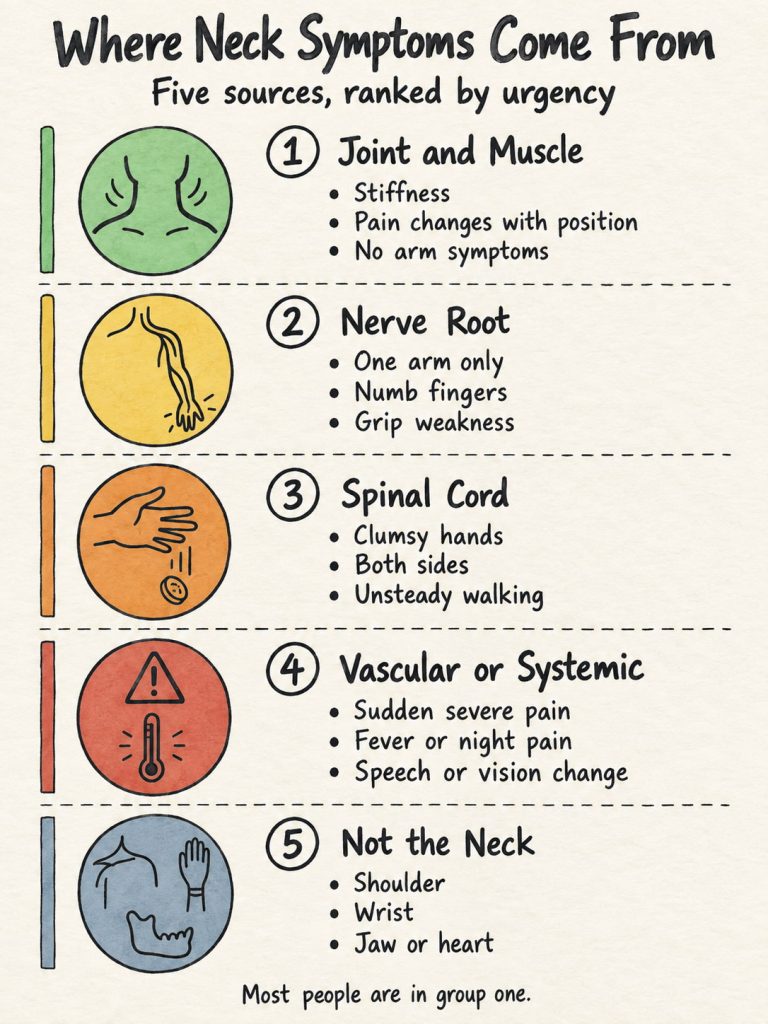
The five sources of cervical spine symptoms
Every neck symptom belongs to one of these five groups. They are listed in order of how common they are, not how serious.
1. Joint, disc and muscle irritation (mechanical)
The everyday group, and where the large majority of people land.
- Pain in the neck, upper trapezius or between the shoulder blades, worse at the end of a long desk day
- Stiffness on turning or looking up, often worse in the morning and easing with movement
- Pain that changes with position, which is the defining feature of mechanical symptoms
- Headaches that start at the base of the skull and wrap toward the forehead on one side
- Clicking or grinding on rotation, which is common and not a sign of damage
- No numbness, no weakness, no symptoms below the elbow
2. Nerve root compression (radiculopathy)
The root is irritated where it exits the spine, so symptoms follow one route down the arm.
- Sharp, burning or electric pain travelling from the neck into the shoulder blade, arm or hand
- Numbness or pins and needles in a stripe, typically one or two fingers rather than the whole hand
- Weakness in a specific action: gripping, pushing a door, raising the arm to shoulder height
- Symptoms that spike with coughing, sneezing or straining
- Relief when you rest the affected hand on top of your head, which is a recognised and oddly specific sign
- Usually one arm only
3. Spinal cord compression (myelopathy)
Pressure on the cord itself rather than a single root. Uncommon, slow to develop, and the group most often missed.
- Difficulty with buttons, zippers, coins or keys, or handwriting that has changed
- Dropping things more than you used to
- Numbness or clumsiness in both hands
- Feeling unsteady walking, particularly in the dark or on stairs
- Heaviness or stiffness in the legs, which surprises people because the problem is in the neck
- New changes in bladder or bowel control, which is a late sign and an emergency
4. Vascular, infection and systemic causes
Rare, and the reason clinicians take a full history instead of going straight to treatment.
- Sudden, severe neck pain unlike anything you have had before, especially with a headache
- Neck pain with fever, night sweats or unexplained weight loss
- Pain that is constant, unrelated to position and wakes you every night
- Neck pain with slurred speech, facial drooping, double vision or loss of balance
- Neck pain with a history of cancer, which changes the assessment significantly
Serious spinal pathology is genuinely rare, and no single warning sign confirms anything by itself. These features are interpreted together, as an index of suspicion built from your whole history rather than a checklist [+].
5. Symptoms that are not coming from your neck
Covered above: rotator cuff, carpal tunnel, thoracic outlet, jaw joint, cardiac referral. This group exists on the list because assuming the neck is responsible is the single most common reason people spend three months doing the wrong exercises.
How fast to act
Categories tell you what a symptom might mean. What you actually need is a response time.
| If you have | Act |
|---|---|
| Sudden severe neck pain with slurred speech, facial droop, double vision or loss of balance | Call 911 now |
| New loss of bladder or bowel control, or numbness around the groin | Emergency department today |
| Neck pain after a car crash, fall or sports impact, with midline tenderness or inability to turn your head 45 degrees each way | Emergency department today, before any treatment |
| Neck pain with fever, or with a history of cancer and constant night pain | Same-day medical assessment |
| Progressive weakness, clumsy hands, unsteady walking | Family doctor within days, imaging is likely needed |
| Arm pain or numbness in a single-nerve pattern, no weakness | Physiotherapy assessment within a week or two |
| Neck stiffness and pain that changes with position | Book when it suits you, and keep moving in the meantime |
The trauma row deserves a note. In Ontario, whether you are imaged after a neck injury is decided by a validated set of rules rather than by how much it hurts, so a clear X-ray after a collision is a reassuring result and not a dismissal of your symptoms.
The two-minute hand check
Of everything on this page, one group is worth a deliberate self-check, because it is the group that gets explained away for years.
Try this. Do up a shirt button. Pick a coin off a flat table. Write a sentence. Then ask whether any of that felt different from six months ago, and whether anyone has commented on your handwriting.
Hand incoordination and altered hand sensation are strikingly specific for spinal cord involvement, with specificity around 92% and 90% respectively, even though neither is sensitive enough to rule the problem out on its own [+]. In plain terms: a clumsy hand does not prove much on its own, but it is a poor symptom to ignore.
It gets ignored a lot. Degenerative cervical myelopathy affects roughly 5% of adults over 40, and misdiagnosis in primary care contributes to an average delay of about two years between first symptoms and diagnosis [+]. Two years of a slowly progressive cord problem is the difference between a manageable situation and permanent change.
If the hand check felt off, book with your family doctor and say the words “I am having trouble with fine motor tasks and my balance.” That sentence changes the conversation.
Nerve root versus spinal cord: the difference that matters
These two get lumped together as “a pinched nerve”, and they behave very differently.
A compressed nerve root affects one arm, follows one route, hurts a great deal, and usually gets better. Most people with cervical radiculopathy improve substantially over weeks to months with non-surgical care, and the overall outlook is good [+]. It is painful, not dangerous.
Cord compression affects both hands, affects walking, involves far less pain, and does not reliably improve with exercise and manual therapy. It is not painful in proportion to how serious it is, which is exactly why it gets underestimated by patients and clinicians alike.
The practical rule: severity of pain tells you how uncomfortable you are. Loss of function tells you how urgent you are.
What an assessment actually involves
Knowing which group you are in is the whole job, and it takes about half of a first appointment.
A physiotherapist screens for the red flags in group four first, then tests reflexes, muscle strength and sensation to separate root involvement from cord involvement, then examines movement, joint mobility and load tolerance. Neck symptoms are then classified into a working category, usually mobility deficits, movement coordination impairment (the whiplash group), neck pain with headache, or neck pain with radiating pain, because treatment is matched to that category rather than applied uniformly.
Two things worth knowing about the Ontario pathway. Physiotherapists here are primary contact practitioners, so you do not need a referral to be assessed, though your insurer may ask for one. And physiotherapists cannot order an MRI, so when imaging is genuinely indicated the appropriate step is a referral back to your family doctor with the findings documented, which is faster than starting over. At Toronto Wellness & Physio Center, assessments for arm and hand symptoms always include the neurological screen before any treatment begins.
If your symptoms turn out to be mechanical, treatment typically combines specific exercise with manual therapy, and may include shockwave therapy, massage therapy or acupuncture as adjuncts where they fit the presentation. They are additions to an active plan, not replacements for it.
What to do yourself in the meantime
For the mechanical group only, and only if you have no weakness and no cord signs. If either applies, stop here and get assessed.
- Chin nods: lying on your back, gently nod as if saying yes, hold three seconds, 10 repetitions, twice a day. Slow and small beats big and fast.
- Isometric holds: press your head lightly into your hand in each of four directions, five seconds each, five rounds, once a day. No movement should occur.
- Scapular rows with a band: three sets of 12, every second day. Most desk-related neck symptoms improve when the mid-back starts contributing.
- Movement breaks: stand and move for two minutes every 40 minutes. Frequency matters more than what you do in the break.
- Pillow height: enough to fill the gap between your head and the mattress, no more. Side sleepers usually need more than they think, back sleepers less.
Expect soreness that settles within 24 hours. If an exercise sends symptoms further down your arm, stop it. Symptoms retreating toward the neck is the direction you want, and symptoms travelling toward the hand is the signal to get assessed rather than push harder.
Two things to avoid: prolonged use of a soft collar, which weakens the muscles you need, and self-manipulating your own neck for the momentary relief of the crack, which does nothing for the underlying irritation.
Where this leaves you
Sort your symptoms into one of the five groups, match that to a response time, and act on the earliest row that applies to you. Most readers will land in group one, feel better within a few weeks of loading the neck properly, and never need imaging. If your symptoms travel down one arm in a stripe, a physiotherapy assessment in the next week or two is the efficient move. If both hands feel clumsy or your balance has changed, take that to a doctor now.
If you are unsure which group you are in, that uncertainty is itself a reason to be assessed. Sorting it out is a single appointment, and treating neck pain that turns out to be something else costs considerably more time than that.
Frequently asked questions
Can cervical spine problems cause dizziness? Yes, and it is one of the more unsettling symptoms. Neck-related dizziness typically feels like unsteadiness or floating rather than the room spinning, tends to follow neck movement or a period of stiffness, and usually occurs alongside neck pain. Spinning vertigo triggered by rolling over in bed is more likely an inner ear issue. Dizziness combined with slurred speech, double vision or facial weakness is an emergency.
Do I need an MRI for cervical spine symptoms? Usually not. Imaging changes management mainly when there are red flags, progressive neurological deficits, cord signs, or a plan for surgery or injection. Because degeneration appears on scans in most people over 60 without causing symptoms, a scan ordered too early often finds something incidental and sends the focus in the wrong direction.
How long should neck symptoms last before I do something? Mechanical neck pain that is easing week by week can be managed at home for two to three weeks. Symptoms that are static or worsening after two weeks, any arm symptoms, and anything neurological should be assessed sooner. Trauma, cord signs and systemic features do not wait at all.
Is it safe to have my neck adjusted? For most people with mechanical neck pain, manual therapy to the neck is well tolerated. It should follow an assessment that has screened for vascular and bone-related concerns, not precede one. Anyone with cord signs, recent significant trauma, sudden unfamiliar severe neck pain, or a systemic red flag should be assessed medically before any hands-on treatment.
Can poor posture alone cause these symptoms? Posture is a contributor rather than a cause. The stronger driver is duration: holding any position for hours is what irritates neck tissue, and the best posture is broadly the next one. Strength and movement frequency change symptoms far more reliably than sitting up straighter does.
Will cervical spine symptoms come back? Neck pain does tend to recur, which is normal and does not mean the first round of treatment failed. Recurrences are usually shorter and milder when strength work continues after symptoms settle. The people who do best are the ones who kept two or three exercises going after they felt fine.