
A whiplash associated disorder grade is a number from 0 to IV that describes how much injury a clinician can actually find in your neck, based on what you feel and what shows up during an examination. It is not a score of how much pain you are in, and it is not a prediction of how long you will take to get better. If you have been given a grade after a car accident, or you have seen the letters WAD on a form and had nobody explain them, this page walks through all four grades in plain language, tells you which ones need urgent medical care today, and explains why in Ontario this single number also affects how much treatment your auto insurer will pay for.
What a whiplash grade actually is
Whiplash happens when your head is thrown quickly in one direction and then snapped back, usually in a rear-end collision. The muscles, ligaments and joints in your neck get stretched faster than they can control. The collection of problems that follows, which can include neck pain, stiffness, headaches, shoulder pain and sometimes dizziness, is called whiplash associated disorder, shortened to WAD.
The grading system came out of a large Canadian review published in 1995 by a group called the Quebec Task Force. They sorted people into five categories from 0 to IV based on two things only: what the person reports, and what a clinician can observe or measure during an examination [+].
That last part is worth sitting with, because it explains a lot of the confusion around grades.
A grade is not:
- A pain score: someone in grade I can be in more pain than someone in grade II. The grade counts findings, not suffering.
- A diagnosis of specific damage: it does not tell you which ligament or which joint is involved. It describes a pattern, not a part.
- Permanent: it describes you on the day you were examined. If your examination changes, your grade changes.
- The same as a concussion: a concussion is a brain injury and sits completely outside this system, which covers the neck only.
- A forecast: it is a poor predictor of how any single person will recover, for reasons covered further down.
Why the grade exists, and why it carries extra weight in Ontario
The original purpose was practical. Before 1995 there was no shared language for whiplash, so two clinicians could describe the same neck in completely different terms. A grading system gave everyone a common shorthand and helped match people to the right level of care.
In Ontario, a second purpose was layered on top. Auto insurance here runs on a rulebook called the Statutory Accident Benefits Schedule, and under it certain injuries are classified as “minor”. The definition of a minor injury names sprains, strains, whiplash associated disorder, bruises, scrapes, cuts and one type of joint displacement, along with any symptoms that flow from those injuries. When your injuries all fit that definition, your treatment funding is handled under the Minor Injury Guideline and capped at $3,500 in total [+].
That $3,500 has to cover everything: physiotherapy, chiropractic care, massage therapy, and the cost of assessments. Outside that category, the available medical and rehabilitation funding is far higher.
So in Ontario your grade is doing two jobs at once. Clinically it tells your therapist how to start. Administratively it sits close to a decision about money. The rest of this page keeps those two jobs separate, because they come apart more often than people expect.
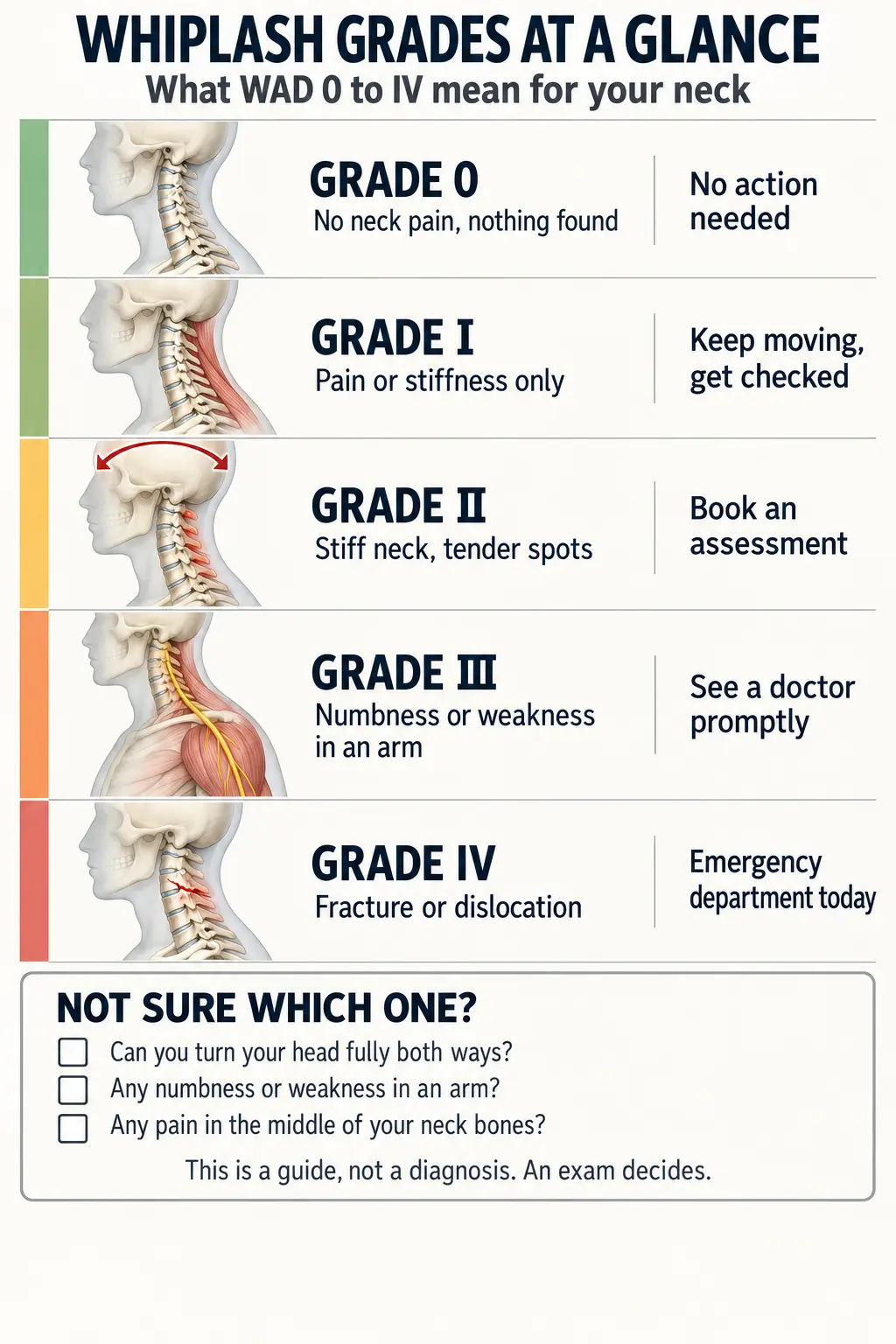
The grades, one by one
Here is each category in ordinary language, with the clinical term and then what it means if you are the person living in that neck.
Grade 0: no neck complaint, no findings
You were in the collision, but you have no neck symptoms at all and nothing shows up on examination. Grade 0 exists mostly so researchers can count people who were exposed to the same event and came out fine. You will rarely see it on your own paperwork.
Grade I: neck pain, stiffness or tenderness, but nothing found on examination
Your neck hurts, feels tight, or is sore to touch. When a clinician examines you, they find nothing objective: your neck moves through its normal range, there is no muscle spasm, nothing is swollen or bruised, and your nerves test normal.
- Pain often starts hours after the crash rather than at the scene, which is normal and does not mean it is imaginary.
- Turning your head feels unpleasant but is not actually restricted.
- Headache at the base of the skull is common.
- This is the group most likely to settle within a few weeks with gentle movement and reassurance.
Grade II: neck pain plus physical findings
This is grade I with something measurable added. The most common findings are reduced range of motion, meaning you genuinely cannot turn or tilt your head as far as you should, and point tenderness, meaning there are specific spots that hurt sharply when pressed.
- Muscle spasm, where muscles on one side of the neck stay tight and will not release, belongs here.
- Headaches, jaw discomfort and pain spreading into the upper back are all common in this group.
- Most people who are injured in a collision and develop neck symptoms end up in grade II [+].
- Because it is the biggest group, it is also the most varied. Two people both graded II can be in very different situations.
Grade II is the one most people are given, and it is where the greatest number of misunderstandings live. Being placed in the most common category tells you less about yourself than it feels like it should.
Grade III: neck pain plus nerve signs
Here the examination finds evidence that a nerve is involved. Clinicians look for three specific things: reflexes that are weaker or absent compared with the other side, actual muscle weakness when strength is tested, and areas of numbness or altered sensation.
- The key word is signs, not symptoms. Pins and needles that come and go is a symptom. A reflex that does not respond is a sign.
- Symptoms usually run into the arm rather than staying in the neck.
- This grade needs medical assessment rather than only physiotherapy, because the cause of the nerve involvement has to be identified.
- It is also the usual boundary at which an Ontario claim stops being treated as a simple soft tissue injury.
Grade IV: fracture or dislocation
The neck bones are broken, or a joint has come out of position. This is a medical emergency, not a rehabilitation problem.
If a broken neck is suspected, go to the emergency department immediately or call 911. Do not drive yourself and do not let anyone move your neck.
Grade IV is rare. It is in the system so that clinicians are forced to rule it out before they treat anything else, not because it is a likely outcome of an ordinary collision.
How urgent is each grade
Categories tell you what a grade means. What you actually need to know is how fast to act.
| Your situation | How urgent | What to do |
|---|---|---|
| Neck pain only, you can move your head, no arm or leg symptoms | Routine | Book an assessment within a few days. Keep moving gently in the meantime |
| Neck pain with stiffness, spasm or tender spots, still no arm or leg symptoms | Routine, but do not wait it out | Book an assessment this week. Early guidance shortens the stiff phase |
| Numbness, weakness, or pins and needles running into one arm | Same day or next day | See a doctor or physiotherapist promptly for a nerve examination |
| Severe midline neck pain, you cannot turn your head at all, or the crash was high speed, a rollover, or an ejection | Emergency | Go to the emergency department today |
| Weakness or numbness in both arms or in the legs, loss of bladder or bowel control, or clumsy hands | Emergency | Call 911 or go to the emergency department immediately |
| Confusion, vomiting, worsening headache, slurred speech, or a headache that came on like a thunderclap | Emergency | Call 911 or go to the emergency department immediately |
The bottom three rows are not about whiplash grades at all. They are about possible spinal cord, brain or blood vessel injury, and they override everything else on this page.
Why imaging is not automatic, and why that is not neglect
Many people leave an emergency department without an X-ray and assume they were brushed off. Usually the opposite happened.
Canadian emergency departments use a decision tool called the Canadian C-Spine Rule, developed by Stiell and colleagues and published in JAMA in 2001. It asks three questions in order: are there high-risk features such as age over 65, a dangerous crash mechanism, or numbness in the limbs; are there low-risk features that make it safe to test movement, such as a simple rear-end collision or being able to walk afterwards; and can the person turn their head 45 degrees to each side. When someone passes through it cleanly, the chance of a meaningful fracture is very low, and an X-ray adds radiation without adding information.
So no X-ray usually means a fracture was actively considered and ruled out, which puts grade IV off the table. That is useful to know, and it is worth asking the question directly if nobody explained it to you.
Whiplash grade and concussion are two separate things
This catches families out constantly, and it matters financially as well as clinically.
The WAD grades describe your neck. A concussion is an injury to the brain, and it is not part of the grading system at any level. You can have a grade II neck and a concussion at the same time, and the grade will say nothing about the second injury.
Symptoms overlap enough to confuse anyone: headache, dizziness, difficulty concentrating and trouble with screens can come from either the neck or the brain. Telling them apart takes an examination, not a symptom list. If any of the following are present, say so explicitly rather than assuming they fall under the neck injury:
- Memory gaps: not recalling the impact itself or the minutes afterwards.
- Fog or slowed thinking: re-reading the same line, losing track mid-conversation.
- Light and noise sensitivity: having to dim screens or leave rooms.
- Mood or sleep changes: irritability or broken sleep that started after the crash.
Concussion is not on the Ontario minor injury list, which is one reason it should never be quietly folded into a neck grade. If these symptoms are part of your picture, concussion rehabilitation is assessed on its own terms.
What happens when you come in for an assessment
An assessment for neck pain after a car accident is mostly conversation and careful testing, and it usually takes about an hour.
Your therapist will ask how the collision happened, where you were sitting, whether your head was turned, when symptoms began, and what you can no longer do comfortably: sleeping, driving, shoulder checks, screen work. Then they measure how far your neck moves in each direction, press to find the tender points, test your strength and reflexes, and check for the emergency features listed above.
At the end you should hear, in plain words, what was found, what it means, what the plan is, and what would make you come back sooner. If you leave without understanding your own grade, ask before you leave the room. It is your information.
What you can safely do in the first two weeks
Everything below assumes serious injury has already been ruled out by a doctor or a physiotherapist. If you have not been examined yet, get examined first, because advice that suits a strained neck is wrong for a fractured one.
- Keep moving: gentle neck rotation to the point where it becomes uncomfortable, not painful, about 10 turns each way, three or four times a day. Movement in the first days is one of the few things that reliably shortens the stiff phase.
- Walk: 10 to 15 minutes, twice a day. It keeps your whole spine moving without loading your neck.
- Skip the collar: soft collars were standard decades ago and are no longer recommended for ordinary whiplash, because holding the neck still makes it stiffer.
- Sleep on one pillow: a single supportive pillow that keeps your head level with your spine. Stacked pillows push your neck into a bent position for eight hours.
- Expect soreness after movement: discomfort that settles within about 24 hours is normal. Pain that keeps building over several days is a reason to be reassessed.
- Go back to normal activity in steps: short drives before long ones, short screen sessions before full days.
Heat, gentle massage and over-the-counter pain relief can all help you move more comfortably. They are there to make movement possible, not to replace it.
What your grade does not tell you
Two things people reasonably expect from a grade, it cannot give them.
- It does not predict your recovery: Most injured people land in the same category, and a category that holds the majority cannot separate individuals well. Recovery varies enormously within grade II, and long-term difficulty after whiplash is common enough that it should be taken seriously rather than dismissed [+]. What tracks better than your grade is your own trajectory: are you turning your head further this week than last, sleeping longer, driving more comfortably. That is what your therapist should be measuring.
- It does not permanently fix your funding category: An early classification is made from early information. If new findings appear, if another injury such as a concussion is identified, or if recovery stalls well beyond what was expected, the classification can be looked at again. That reassessment is driven by documented clinical findings over time, which is a concrete reason to attend appointments and report changes honestly rather than downplaying them. Insurance decisions themselves are not a clinical matter, and questions about your claim belong with your insurer or a lawyer.
What to do next
If you have arm or leg symptoms, severe midline neck pain, or any of the emergency features listed above, deal with those today through a doctor or an emergency department. Nothing else on this page comes before that.
If your symptoms are limited to your neck, get examined within the first week or so. An early assessment gives you three things: serious injury ruled out properly, a starting point that other people’s recovery cannot give you, and a clinical record that begins at the start of your injury rather than three months in.
🚨 Before you rely on any of this
This article is general information about how whiplash grades work. It is not a diagnosis, and it cannot be one, because two necks that read identically in writing are regularly two different injuries in person. The findings that separate grade II from grade III, in particular, are things a clinician tests with their hands, not things you can check on yourself. If your neck was injured in a collision, an in-person assessment gives you a grade you can trust and a plan built around your own findings, and it starts a clinical record from the beginning of your injury rather than months later. You can book an assessment for physiotherapy in Richmond Hill or physiotherapy in North York. If you have numbness or weakness in both arms or your legs, loss of bladder or bowel control, or severe midline neck pain, go to the emergency department today rather than booking anything.
Frequently asked questions
Can my whiplash grade change? Yes. The grade reflects a single examination. If nerve signs appear that were not there at first, or findings resolve, the grade is updated to match. It is a description, not a permanent label.
I was told grade II. Is that serious? Grade II means a clinician found something measurable, usually restricted movement or tender points, without nerve involvement. It is the most common category and most people in it improve, but it covers a wide range, so your own progress matters more than the number.
Why did nobody X-ray my neck? Canadian emergency departments use a validated decision rule to decide who needs imaging. Passing through it means a meaningful fracture was considered unlikely. Ask directly if it was not explained.
My pain started two days after the crash. Does that count? Yes. Delayed onset is typical, partly because adrenaline masks symptoms at the scene and partly because inflammation builds over the following day or two. It does not weaken your injury or your record of it.
Is a concussion part of my whiplash grade? No. The grading system covers the neck only. A concussion is assessed separately and is not included in Ontario’s minor injury definition, so it should be raised explicitly rather than assumed to be covered.
Does a higher grade mean a longer recovery? Not reliably. Higher grades involve more findings and more caution, but recovery within any grade varies widely. Measured change in your own function is the better guide.