
Yes, a cervical herniated disc can cause dizziness, but it is not the usual cause, and the link is less direct than most websites suggest. When the neck is the source, the dizziness tends to feel like unsteadiness or a floating, off-balance sensation rather than the room spinning, and it comes and goes with neck pain, stiffness or particular neck positions.
Because dizziness has many causes and several of them are serious, neck-related dizziness is only confirmed once other causes have been ruled out. This article explains how a disc might cause dizziness, what else produces the same feeling, and how quickly to act.
Start with the urgent part. If dizziness comes with double vision, slurred speech, trouble swallowing, facial numbness, weakness on one side, a sudden severe headache or neck pain unlike anything you have had before, call 911. Those can be signs of a stroke or a torn neck artery.
Part of the confusion comes from the words themselves. “Dizziness” covers several different sensations, and only some of them fit a neck problem.
What neck-related dizziness is, and what it is not
Clinicians call dizziness that comes from the neck cervicogenic dizziness. It is defined as dizziness together with neck pain, where the dizziness is closely tied to neck position or movement, and it is a diagnosis of exclusion because there is no single test that confirms it [+].
A herniated disc is one possible driver of it. So are stiff neck joints, whiplash and long-standing neck pain without any disc injury at all.
Typical features:
- Unsteadiness, light-headedness or feeling “off” rather than true spinning
- Starts with, or worsens with, a flare of neck pain or stiffness
- Brought on by holding the head in one position (looking down at a phone, reversing the car) or by turning the head
- Often comes with reduced neck movement and sometimes a headache at the back of the head
What it usually is not:
- Not room-spinning vertigo lasting seconds when you roll over in bed. That pattern points to the inner ear.
- Not fainting or nearly blacking out when you stand up. That points to blood pressure.
- Not dizziness with speech, vision or swallowing changes. That needs emergency assessment.
How a disc in the neck could cause dizziness
Your balance system relies on three inputs: the inner ear, your eyes, and position sensors in the muscles and joints of the upper neck. When the neck is painful, stiff or injured, the signals it sends can stop matching what the eyes and inner ear report, and the brain experiences that mismatch as unsteadiness.
The disc-specific link is newer and less settled. One research group has proposed that degenerated cervical discs contain nerve endings that feed into this balance system. In their prospective study of 145 people with cervical spondylosis and dizziness, those who had anterior neck surgery reported less intense and less frequent dizziness over a year than those treated without surgery [+]. The study was not randomised, and patients chose their own treatment, so it supports a link without proving cause.
A small 2025 study adds to the picture. Of 40 people with lower cervical disc herniation, 23 (57.5%) reported dizziness, and their vestibular test results differed from those of 40 healthy controls [+].
The honest summary: a disc can plausibly contribute, the evidence is early, and a disc seen on an MRI does not on its own explain why someone is dizzy. Disc bulges are common in people with no symptoms at all.
That is why the more useful question is usually not “is it my disc?” but “what else could this be?”
Causes of dizziness, grouped by where they come from
Neck (cervicogenic)
- Herniated or degenerated cervical disc
- Stiff or irritated upper neck joints
- Whiplash and other neck injuries
- Long-standing neck pain with poor neck position sense
- Usually unsteadiness with neck pain, worse with sustained or end-range neck positions
Inner ear (vestibular)
- Benign paroxysmal positional vertigo (BPPV): short bursts of spinning when you lie down, roll over or look up
- Vestibular neuritis or labyrinthitis: severe spinning lasting days, often after a cold
- Ménière’s disease: spinning attacks with hearing loss, ringing and fullness in one ear
- Vestibular migraine: dizziness episodes with or without headache
BPPV is far more common than neck-related dizziness. In a German population study, about one in three people with vestibular vertigo had BPPV [+], and a single repositioning manoeuvre often settles it.
Blood vessels and the brain
- Stroke or transient ischaemic attack (mini-stroke)
- Cervical artery dissection, a tear in an artery in the neck, sometimes after minor trauma
- Warning features include the “5 Ds and 3 Ns”: dizziness, double vision, difficulty speaking, difficulty swallowing, drop attacks, nystagmus (jerking eye movements), nausea and numbness around the mouth [+]
Spinal cord
- Severe disc herniation or narrowing that presses on the spinal cord (myelopathy)
- Feels like unsteady walking, especially in the dark, rather than dizziness
- Often with clumsy hands, trouble with buttons or handwriting, and heavy or stiff legs
Heart, blood pressure and blood
- Low blood pressure on standing (light-headed when you get up quickly)
- Heart rhythm problems
- Low blood sugar, anaemia or dehydration
Medication and other causes
- Blood pressure tablets, sedatives, some antidepressants and pain medications
- Anxiety and panic, which can cause real, physical dizziness
- Persistent postural-perceptual dizziness (PPPD), a long-lasting unsteadiness that often follows another dizziness episode
Knowing the categories helps. Most people with neck pain and dizziness want a simpler answer: how worried should I be, and how fast should I act?
How urgently to act on dizziness with neck pain
| What you notice | What it may mean | What to do |
|---|---|---|
| Dizziness with double vision, slurred speech, swallowing trouble, facial numbness, one-sided weakness or a sudden severe new headache | Possible stroke or artery dissection | Call 911 now |
| New, severe, unfamiliar neck pain or headache, especially after minor trauma or neck manipulation | Possible artery dissection | Emergency department now |
| Unsteady walking, clumsy hands, numbness in both hands, or bladder changes | Possible spinal cord compression | See a doctor within 24 to 48 hours; same day if worsening quickly |
| Fainting, chest pain, palpitations or breathlessness with dizziness | Possible heart cause | Emergency department now |
| Brief spinning when you lie down, roll over or look up | Likely BPPV | Book a vestibular assessment |
| Unsteadiness that rises and falls with neck pain and stiffness | Possible cervicogenic dizziness | Book an assessment that covers neck and inner ear |
For most people in the last two rows, the outlook is good. Both BPPV and neck-related dizziness respond well to targeted treatment.
The two least urgent rows are also the two most often mixed up, which is where a careful assessment earns its keep.
Neck dizziness vs inner ear dizziness: how they differ
Neck-related dizziness: Unsteady, floating or light-headed. Rises and falls with neck pain. Brought on by sustained neck positions or neck movement, and can last minutes to hours. No hearing changes.
BPPV: True spinning that lasts under a minute. Triggered by a change of head position relative to gravity (lying down, rolling over, tipping the head back), not by neck pain. Often worst first thing in the morning.
The overlap is that turning the head can trigger both. A clinician tells them apart by moving the head while keeping the neck still, and moving the neck while keeping the head still, and watching the eyes during each.
People with neck pain can also have BPPV at the same time, so finding one problem does not rule out the other.
What happens at an assessment for neck-related dizziness
Expect your physiotherapist to start by screening out the causes in the urgent rows above, and to refer you on if anything does not fit. A typical assessment covers:
- A detailed history: what the dizziness feels like, how long it lasts, what triggers it, and how it relates to your neck pain
- Screening questions and checks for stroke, artery and spinal cord warning signs
- Positional tests for BPPV, such as the Dix-Hallpike test
- Neck movement, joint stiffness and muscle tenderness
- Neck position sense (how accurately you can return your head to centre with your eyes closed)
- Eye-tracking tests with the body turned and the head still, which help separate neck input from inner ear input
- Balance testing
If the picture fits cervicogenic dizziness, treatment usually combines neck manual therapy, exercises to restore neck position sense and eye-head coordination, and balance training. In a randomised trial of 86 people with chronic cervicogenic dizziness, two forms of neck mobilisation both reduced dizziness intensity compared with placebo, and the effect lasted at least 12 weeks [+].
In Ontario you can see a physiotherapist without a referral. Physiotherapists cannot order an MRI, so if your assessment suggests spinal cord involvement or another medical cause, you will be referred to your family doctor or the emergency department.
What you can do while waiting for an assessment
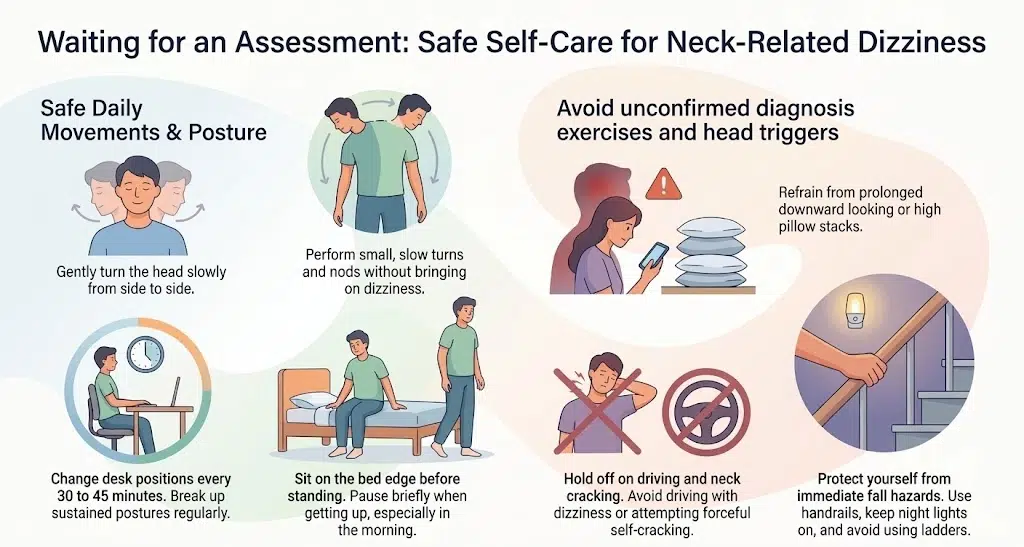
Until the cause has been identified, keep self-care to safety and comfort. Avoid starting exercises aimed at a diagnosis you have not had confirmed.
- Move your neck gently, within comfort: Small, slow turns and nods through a range that does not bring on dizziness, a few times a day. Stiffness tends to make neck-related dizziness worse.
- Avoid positions that trigger it: Long periods looking down at a phone or laptop, sleeping on a high stack of pillows, or holding the head turned for long stretches.
- Break up sustained postures: Change position every 30 to 45 minutes when working at a desk.
- Get up slowly: Sit on the edge of the bed for a few seconds before standing, especially in the morning.
- Protect yourself from falls: Use handrails, keep a night light on and avoid ladders until you know what is going on.
- Hold off on driving and neck cracking: Do not drive while you are dizzy, and avoid neck manipulation or forceful self-cracking until warning signs have been ruled out.
Can neck dizziness be permanent?
Most people with neck-related dizziness improve once the neck problem is treated, often over several weeks. It tends to linger when the neck pain itself is long-standing or when people start avoiding head movement, because the balance system then has fewer chances to recalibrate.
Surgery is rarely needed for dizziness alone. It is considered when a disc is compressing the spinal cord or a nerve root and causing progressive weakness or other neurological signs, and that decision sits with a spine surgeon.
What to do next
If your dizziness fits the neck pattern (unsteadiness that follows neck pain and stiffness) and none of the urgent signs apply, the next step is an assessment that looks at the neck and the inner ear together. If any urgent sign applies, skip that step and get emergency care first.
Toronto Wellness & Physio Center sees people with neck-related dizziness through our neck pain treatment and vestibular programs. For a wider look at how neck problems produce symptoms elsewhere in the body, see our guide to cervical spine symptoms.
Frequently asked questions
Can a bulging disc in the neck cause dizziness and headaches?
It can contribute to both, usually alongside neck pain and stiffness. Headaches from the neck typically start at the back of the head. Because disc bulges are common in people without symptoms, a bulge on a scan does not prove it is the cause.
What does cervicogenic dizziness feel like?
Most people describe unsteadiness, light-headedness or feeling off balance rather than spinning. It usually comes and goes with neck pain, and is brought on by turning the head or holding it in one position for a long time.
Can a pinched nerve in the neck cause dizziness?
A pinched nerve root in the lower neck usually causes arm pain, tingling or weakness rather than dizziness. Dizziness is more often linked to problems in the upper neck joints and muscles, which carry more balance-related input.
When is dizziness with neck pain an emergency?
Call 911 if dizziness comes with double vision, slurred speech, trouble swallowing, facial numbness, one-sided weakness, fainting, or a sudden severe headache or neck pain unlike anything before.
Should I get an MRI for neck-related dizziness?
Not usually at first. An MRI is useful when there are signs of spinal cord or nerve compression, or when another serious cause is suspected. For most people, a clinical assessment answers more than a scan.
Can physiotherapy help dizziness from the neck?
Yes, when the neck is confirmed as the source. Neck mobilisation, position-sense exercises and balance training have shown sustained reductions in dizziness in clinical trials.