
Your shoulder wakes you at night, reaching for the seatbelt sends a jolt down your arm, and someone has told you it’s probably your rotator cuff. Or maybe a frozen shoulder. The quickest way to separate frozen shoulder vs rotator cuff injury is to ask whether the arm is stiff or weak. A frozen shoulder is a tight joint capsule, so the arm stays stuck even when someone else tries to move it. A rotator cuff injury is a tendon problem: the joint still moves, but lifting hurts or gives way.
Two things most people want to know straight away. Neither condition usually ends in surgery. And they need different handling in the first few weeks, because an irritable, freezing capsule flares if you stretch it hard while an irritated cuff gets weaker if you rest it. Getting that backwards is the most common way people lose a month.
If your pain started with a fall and you can’t move your arm, or the shoulder is hot and swollen and you feel feverish, skip the rest of this page and go to the emergency department today.
Nearly every difference further down comes back to which structure is involved, so start there.
What each one actually is
Your shoulder’s ball and socket sit inside a sleeve of connective tissue called the capsule. In adhesive capsulitis, the medical name for frozen shoulder, that sleeve gets inflamed, then thickens and shrinks, and the joint has less room to move in any direction. It tends to run through a painful phase, a stiff phase and a recovery phase. Real shoulders rarely keep to that script.
The rotator cuff is four small muscles whose tendons wrap the top of the arm bone and keep the ball centred while the bigger muscles do the lifting. “Rotator cuff injury” is a loose term. Most of the time it means rotator cuff tendinopathy, tendons that are irritated and overloaded but not torn. Partial and full-thickness tears sit further along. Tears become common after 60, and many never cause a symptom.
Three other problems borrow the same complaints. Arthritis of the shoulder joint stiffens it much like a frozen shoulder does, which is why an X-ray is sometimes needed. A pinched nerve in the neck can send pain to the shoulder, though it usually travels past the elbow and brings tingling with it. A dislocation follows an obvious injury and belongs in the emergency department. If you’re still not sure the problem sits in the shoulder at all, our page on shoulder pain treatment covers AC joint pain, biceps tendon pain and the other usual suspects.
With structures this different, you’d expect the two to be easy to tell apart. They aren’t.
Why the two get confused
Same people, same complaints. Both are most common between about 40 and 65. Both hurt at night, both make it miserable to tuck in a shirt or do up a bra behind your back, and both can start with no injury at all.
Timing is the bigger problem. In the first weeks of a frozen shoulder the arm isn’t locked yet. Pain and muscle guarding hold it back, and if you move slowly it may still go most of the way. That is exactly the window in which frozen shoulders get labelled as cuff problems, and the real stiffness often shows itself only a month or two later.
Health history gets overlooked more than anything else. People with diabetes are about five times more likely to develop a frozen shoulder, and roughly 30% of people who have one turn out to have diabetes, which is why the authors of the largest review on the subject recommend considering diabetes screening [+]. Thyroid disease shows a similar link. If you’ve been told it’s a frozen shoulder and nobody has checked your blood sugar in the past year, raise it with your family doctor.
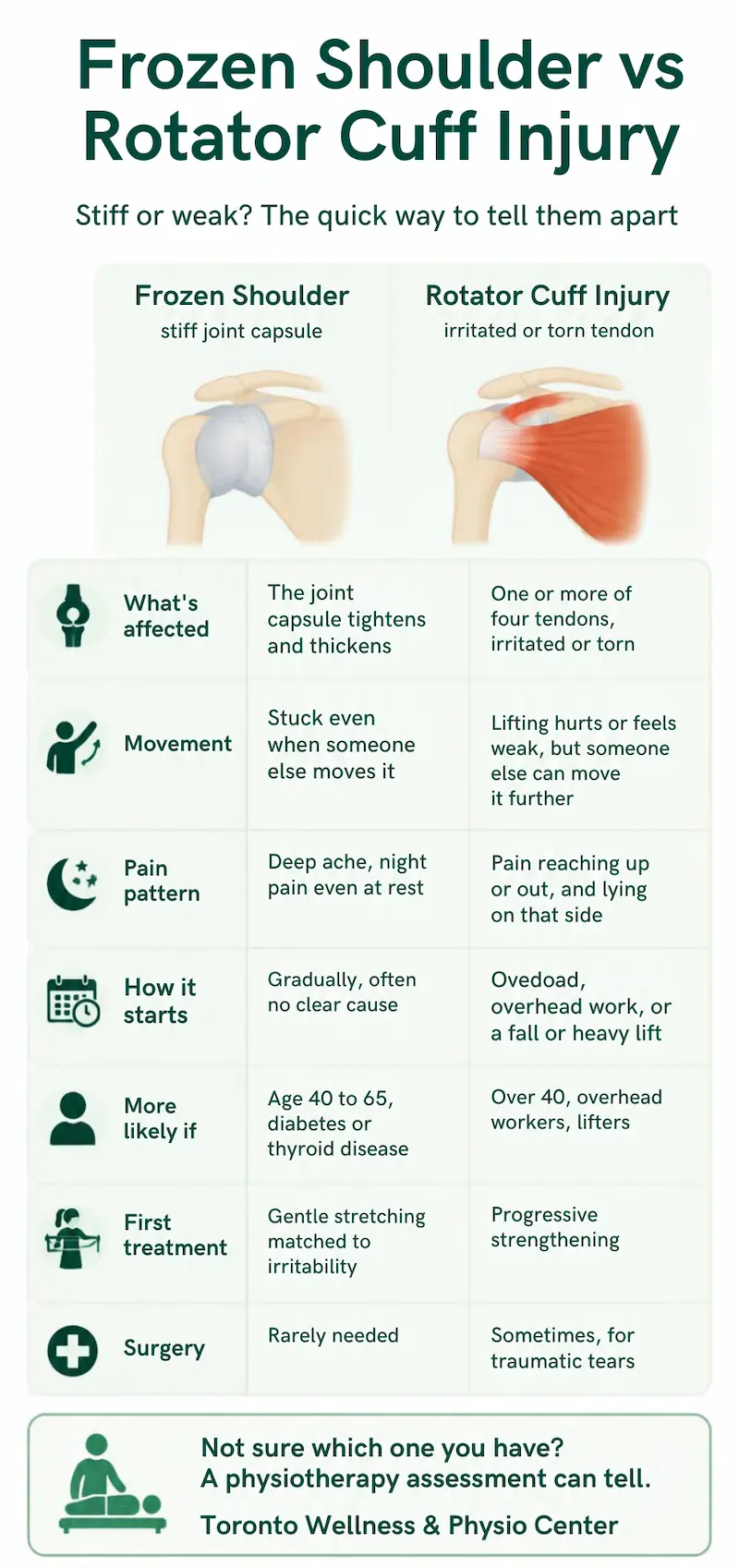
Frozen shoulder vs rotator cuff injury at a glance
| Frozen shoulder | Rotator cuff injury | |
|---|---|---|
| What’s affected | The joint capsule, thickened and contracted | One or more of four tendons, irritated or torn |
| Movement | Limited whether you move it or someone else does; turning the arm outward is usually hit hardest | Your own lifting is painful or weak, but someone else can usually move the arm further |
| Pain pattern | Deep ache, often into the upper arm; night pain even lying still; sharp twinges at the end of range | Outer upper arm, with particular movements such as reaching up or out, and when lying on that side |
| How it starts | Gradually, often with no clear cause | Overload, repeated overhead work, or a single fall, jerk or heavy lift |
| Who’s more likely | Ages 40 to 65, women slightly more often, people with diabetes or thyroid disease, after a spell in a sling | Over 40, overhead workers, lifters, smokers |
| Usual first treatment | Stretching matched to how irritable it is, sometimes a steroid injection | Progressive strengthening |
| Surgery | Only for the minority that stay severely stiff | Considered for acute traumatic tears and some tears that don’t respond |
Of those rows, movement is the one you can check yourself. It is also the one that misleads people most often.
The movement test, and where it misleads
Tuck your elbow against your side, bend it to a right angle, and turn your forearm outward as if opening a door away from you. That movement, external rotation, is usually the first thing a frozen shoulder takes away, often by half or more compared with your good side. What gives it away is that it stays blocked when someone else turns your arm while you relax. A cuff problem behaves differently: a helper can usually take the arm well past the point you reach on your own.
Four situations break that rule. An early frozen shoulder still has some give, because guarding rather than a fixed block is doing the limiting, so it can pass for a cuff problem. A badly irritated cuff does the reverse; when every movement hurts, you tense against the helper and the shoulder looks stiff. Arthritis blocks passive rotation as well, and only an X-ray settles that one. Occasionally someone can barely lift the arm while a helper lifts it with ease, which points to a large cuff tear and should be looked at soon.
Treat the test as something to mention at your appointment. It can’t give you a diagnosis, and here the diagnosis matters more than usual, because the two treatments pull in opposite directions.
Why the treatment runs in opposite directions
With a frozen shoulder, the right dose depends on how irritable the capsule is at the moment. The main physiotherapy guideline recommends stretching but ties its intensity to that irritability [+]. Clinicians grade it roughly like this, and your own answers usually place you quickly:
- High irritability: Pain around 7 out of 10 or worse, pain at rest or at night most of the time, and pain that arrives before you reach the end of the movement.
- Moderate irritability: Pain around 4 to 6, night pain that comes and goes, discomfort mainly at the end of the range.
- Low irritability: Pain of 3 or less, no night pain, and discomfort only when the arm is pushed past its end point.
A highly irritable shoulder needs gentle, pain-free movement and very little else. This is where much of the advice online goes wrong. Pushing hard into the stiffness at this stage usually inflames the capsule further, and people who “stretched through it” tend to report worse nights, with no extra range to show for them. As irritability drops, stretches get longer and firmer and hands-on joint mobilisation becomes useful. A steroid injection from your doctor can make the painful phase more bearable and exercise easier to tolerate.
Expect it to take a while. Most people have little or no disability by 12 to 18 months, though some mild stiffness can hang on. Physiotherapy doesn’t cut the condition short so much as keep you working through it and win back range as the capsule allows.
A rotator cuff injury wants load. Tendons lose capacity when they’re rested and build it when they’re loaded gradually, so the plan strengthens the cuff and the shoulder blade muscles over several weeks. That holds for many full-thickness tears too. In a study of 452 people with non-traumatic full-thickness tears, about 75% hadn’t needed surgery two years after a physiotherapy program, most of it done at home with roughly one clinic visit a week [+]. People who did opt for surgery mostly decided between weeks 6 and 12, which makes the 12-week mark a sensible point to review your own progress.
A tear from a specific injury is another matter, and it’s the one case where waiting can cost you.
How fast to act
Most shoulder pain, these two included, can wait for a routine appointment. A tear caused by a traumatic event should go urgently to a shoulder specialist, and a suspected joint infection or a dislocation that hasn’t gone back in needs same-day emergency care [+].
| What you notice | What it may mean | What to do |
|---|---|---|
| Shoulder or arm pain with chest pressure, shortness of breath, sweating, nausea or jaw pain | A heart problem | Call 911 |
| After a fall or accident, the shoulder looks deformed or you can’t move the arm at all | Possible dislocation or fracture | Go to the emergency department today |
| A hot, red, swollen shoulder with fever or feeling unwell | Possible joint infection | Go to the emergency department today |
| Sudden loss of the ability to lift your arm after a fall, jerk or heavy lift, especially if you’re over 40 | Possible acute traumatic rotator cuff tear | See your family doctor or a physiotherapist within a few days and ask about urgent referral to a shoulder specialist |
| New or worsening arm weakness, or numbness spreading down the arm | Possible nerve involvement from the neck | See your doctor within a few days |
| Stiffness that keeps increasing, night pain that wakes you, trouble reaching your back pocket | Possible frozen shoulder | Book an assessment within one to two weeks |
| Aching with overhead use or lying on that side, with full movement | Likely rotator cuff tendinopathy | Book an assessment; most settle with guided exercise over 6 to 12 weeks |
Even at the bottom of the table the next step is the same. Someone needs to examine the shoulder.
What happens at an assessment
Most of the first visit is conversation and movement testing. Expect questions about how it started, any fall or lift, what wakes you at night, and whether you have diabetes or thyroid disease. Your neck gets checked too, since neck problems send pain into the shoulder more often than people expect.
The central part is a comparison: how far you move the arm, against how far it moves when the physiotherapist moves it, in several directions and especially in rotation at your side. Resisted tests in set positions pick out individual cuff tendons. Your physiotherapist will also grade irritability with the markers above, because that decides how hard the first few weeks should be.
Scans come in when they would change the plan. An X-ray is worth having when passive rotation is clearly lost, to rule out arthritis. Ultrasound or MRI makes sense after a traumatic injury, or when strength hasn’t improved after about 12 weeks of proper rehab and surgery is being discussed. For a shoulder that came on gradually with a clear pattern, a scan often adds little and can point you the wrong way.
Visit frequency differs too. A cuff problem is usually seen about weekly at first, then less often as you take over the program. A frozen shoulder in its painful phase often does better with fewer, spaced-out visits and a short home routine, since an irritable capsule doesn’t benefit from being worked on more.
What you can do this week
Before anyone has examined it, stick to what is safe for both conditions. Keep using the arm for light jobs below shoulder height, and leave the sling in the cupboard unless a doctor has told you to wear one. Don’t force stretches through sharp pain, and hold off on new heavy lifting or overhead gym work. Ask a pharmacist or your doctor which over-the-counter pain relief suits you, particularly if you take other medications.
Nights are where most people struggle. Lying on the sore side is usually out. On your back, a folded towel or small pillow under the elbow keeps the arm slightly forward of your body and eases the front of the shoulder. On the good side, hug a pillow so the sore arm rests on it instead of dropping across your chest. Some people with a painful frozen shoulder sleep better propped up for a few weeks.
Once your physiotherapist has confirmed what you have, these are common starting points, adjusted to you.
- Irritable frozen shoulder: Pendulum swings and table slides, 1 to 2 minutes each, three or four times a day, in a range that brings no more than mild discomfort fading within minutes.
- Stiff, calmer frozen shoulder: Stretch toward the restricted direction, usually turning the arm outward. Hold 30 to 60 seconds, three to five times, twice a day. An ache that settles within an hour is fine. Still sore the next day? You pushed too hard.
- Rotator cuff tendinopathy: Outward rotation against a light resistance band, elbow at your side, 3 sets of 10 to 15 every second day. Pain up to about 3 or 4 out of 10 during the sets is acceptable if it has settled by the next morning, and when the last few reps feel easy, move to a stronger band.
Heat, ultrasound and TENS can take the edge off pain for a few hours. On their own they won’t change how either condition runs.
Can you have both at once?
Yes. A painful cuff that you stop using can stiffen over time, and a frozen shoulder can follow a few weeks in a sling or cuff surgery. When both are present the stiffness usually gets dealt with first, since you can’t strengthen through a range you don’t have.
The more common mix-up runs the other way. Because cuff tears are so frequent after 60, an MRI of a frozen shoulder can show a tear that has nothing to do with the stiffness, and the capsule then goes untreated for months while everyone focuses on the tendon. If the report says “tear” but your real complaint is that the arm won’t move even when someone else moves it, ask whether the capsule has been properly examined.
Getting assessed in Ontario
You don’t need a referral to book a physiotherapist in Ontario. Adults between 20 and 64 usually pay privately or claim through extended health benefits, and some plans still want a doctor’s note before they reimburse, so check yours first. Government-funded physiotherapy covers people 65 or older, 19 or younger, anyone after an overnight hospital stay or day surgery for a related condition in the past 12 months, and people receiving Ontario Works or ODSP [+].
Blood work, steroid injections, OHIP-covered imaging and specialist referrals go through your family doctor, and physiotherapy runs alongside that. Toronto Wellness & Physio Center direct-bills most insurers at both clinics, so if your plan covers physiotherapy you usually pay only the part it doesn’t.
Frequently asked questions
Can a rotator cuff injury turn into a frozen shoulder? It can set one off. A sore cuff that you stop moving can gradually stiffen, and stiffness is a known complication after cuff surgery. Keeping the arm moving within comfortable limits is the best protection.
I can’t lift my arm. Does that mean it’s torn? Not necessarily. Pain alone can stop you lifting, and so can a stiff capsule or a nerve problem from the neck. If you lost the ability suddenly after a fall or heavy lift, get it checked within a few days. If it came on gradually, a routine assessment is fine.
How long does each one take to get better? Cuff tendinopathy usually improves noticeably within 6 to 12 weeks of steady exercise. Frozen shoulder is slower, and most people have little or no disability by 12 to 18 months.
Should I stretch or rest a painful shoulder? Neither, until you know what it is. An irritable frozen shoulder needs gentle movement rather than hard stretching, and a cuff injury needs gradual strengthening rather than rest.
Do I need an MRI to tell them apart? Usually not. Comparing how far you move the arm with how far someone else can move it tells most of the story. Imaging is kept for traumatic injuries, suspected arthritis, or cases where surgery is on the table.
Which is more painful, frozen shoulder or a rotator cuff tear? Both can be very painful, especially at night. How much it hurts won’t tell you which one you have.