
Leaking after the catheter comes out is expected, not a sign that surgery went wrong. Removing the prostate takes away part of the system that keeps urine in, and the muscles left behind have to learn to do more of the job. For most men that happens over months: urology guidelines tell surgeons to warn patients that leaking is normal early on and usually returns close to baseline by 12 months, though for some it persists and needs treatment [+].
Physiotherapy after prostatectomy exists to make that recovery faster, and to spot early the men who are not on track.
Before anything else: fever or chills, being unable to pass urine after the catheter is removed, heavy bleeding with clots, or a swollen painful calf or sudden breathlessness after surgery are not physio problems. Call your surgical team or go to the emergency department.
We can see you before surgery to learn the right contraction, then pick up the programme as soon as your catheter is out, with pad counts and a clear month-by-month plan.
Pelvic floor physiotherapy in Richmond Hill · Pelvic floor physiotherapy in North York
Most men are handed a sheet of Kegel exercises at discharge and assume that covers it. Knowing what post-prostatectomy physio actually involves makes it easier to judge whether you need more than the sheet.
What prostate surgery physio is, and what it is not
It is pelvic floor physiotherapy adapted to the male anatomy after surgery: an assessment of how your pelvic floor and urethral sphincter work, a training programme built on that, and regular review of how much you are leaking. The same approach applies after radiation, after TURP for an enlarged prostate, and when two treatments have been combined.
What it is not:
- A replacement for your urologist’s follow-up. Physio works alongside it.
- Only strengthening. Some men clench too hard or too constantly, and need to learn to relax as well as squeeze.
- Something that has to wait until you are desperate. It works best started before surgery or in the first weeks after the catheter comes out.
- Just for men who leak a lot. Men with a few drops when they stand up benefit too, because small leaks are often the easiest to fix.
To see why the training for men differs from the leaflet version, it helps to know what the surgery changed.
Why men leak after prostatectomy
Before surgery, two systems keep urine in. One sits at the neck of the bladder, working automatically. The other is the striated urethral sphincter, a ring of muscle below the prostate that you can tighten on purpose, backed up by the rest of the pelvic floor.
A radical prostatectomy removes the prostate together with much of the first system. The urethra is reconnected to the bladder, and the voluntary sphincter now carries most of the load. Swelling and nerve stretching from the operation weaken it further for a while.
That explains the typical pattern:
- Leaking when you stand up, cough, lift or bend, because pressure spikes beat a sphincter that is not yet strong or quick enough.
- Drier mornings and wetter evenings, because the muscle tires through the day.
- Leaks during exertion at first, which settle before leaks during quiet standing do.
- Occasional urgency, which is often a separate bladder issue and is treated differently.
In a guideline review of long-term data, between 14% and 25% of men still reported bothersome leakage ten years after prostatectomy [+]. Most men recover well, but not all, which is why recovery is worth tracking rather than waiting out.
If the sphincter is doing the work, the next question is whether generic Kegels actually train it.
Why the right cue matters for men
The standard instruction, “squeeze as if you are holding in wind”, mainly works the muscles around the anus. It does engage the pelvic floor, but it is not the best way to reach the muscle that closes the urethra.
Research using ultrasound and muscle recordings in men found that the wording of the instruction changes which muscles switch on. Cues such as “shorten the penis” or “stop the flow of urine” produced the most activity in the urethral sphincter and the most movement at the mid-urethra, while “tighten around the anus” mostly worked the anal sphincter [+].
In practice, that means:
- Your physiotherapist will usually teach the urethral cue first, then check with observation, ultrasound or an internal exam that the right muscle is working.
- Holding your breath or tightening your stomach and buttocks is a sign the cue has not landed.
- Once the contraction is right, training builds endurance (so evenings stop being worse), speed (for coughs and standing up) and control during real movements like getting out of a car.
Getting the contraction right is step one. What comes after depends on where you are in recovery.
Your first year, stage by stage
Before surgery
- Learn the correct contraction while you are well and have no catheter.
- Practise it lying, sitting and standing so it is automatic by the time you need it.
- Guidelines allow surgeons to offer pelvic floor training before prostatectomy, and many teams now refer for it.
- One or two sessions are often enough at this stage.
While the catheter is in
- Most surgical teams ask you to hold off pelvic floor exercises until the catheter is removed. Follow your surgeon’s instructions.
- Walk, rest, and avoid constipation. Straining is the enemy of a healing join.
The first two weeks after catheter removal
- Heavy leaking is common. Many men use several pads a day at first.
- Start gentle contractions as instructed, little and often, in lying and sitting.
- Count your pads each day. This number is your main progress measure.
Six weeks to three months
- The programme progresses to standing, walking and daily tasks.
- Timed contractions before standing, coughing and lifting get practised until they happen automatically.
- Most men see a clear downward trend in pad use in this window.
Three to six months
- Focus shifts to endurance and fitness activities: golf, gym, cycling once cleared.
- If you are still leaking heavily at six months, this is the point to talk to your urologist, not just keep waiting. Guidelines note that men with severe leakage at six months, or ongoing leakage at one year, may consider surgical treatment [+].
Six to twelve months and beyond
- Many men are dry or close to it, or down to a safety pad.
- Continuing the exercises a few times a week helps keep the gains.
- Ongoing leakage at 12 months is not something you simply have to live with. It is the usual point for a surgical assessment.
Knowing the normal trajectory is useful. Knowing when something is not normal is more useful.
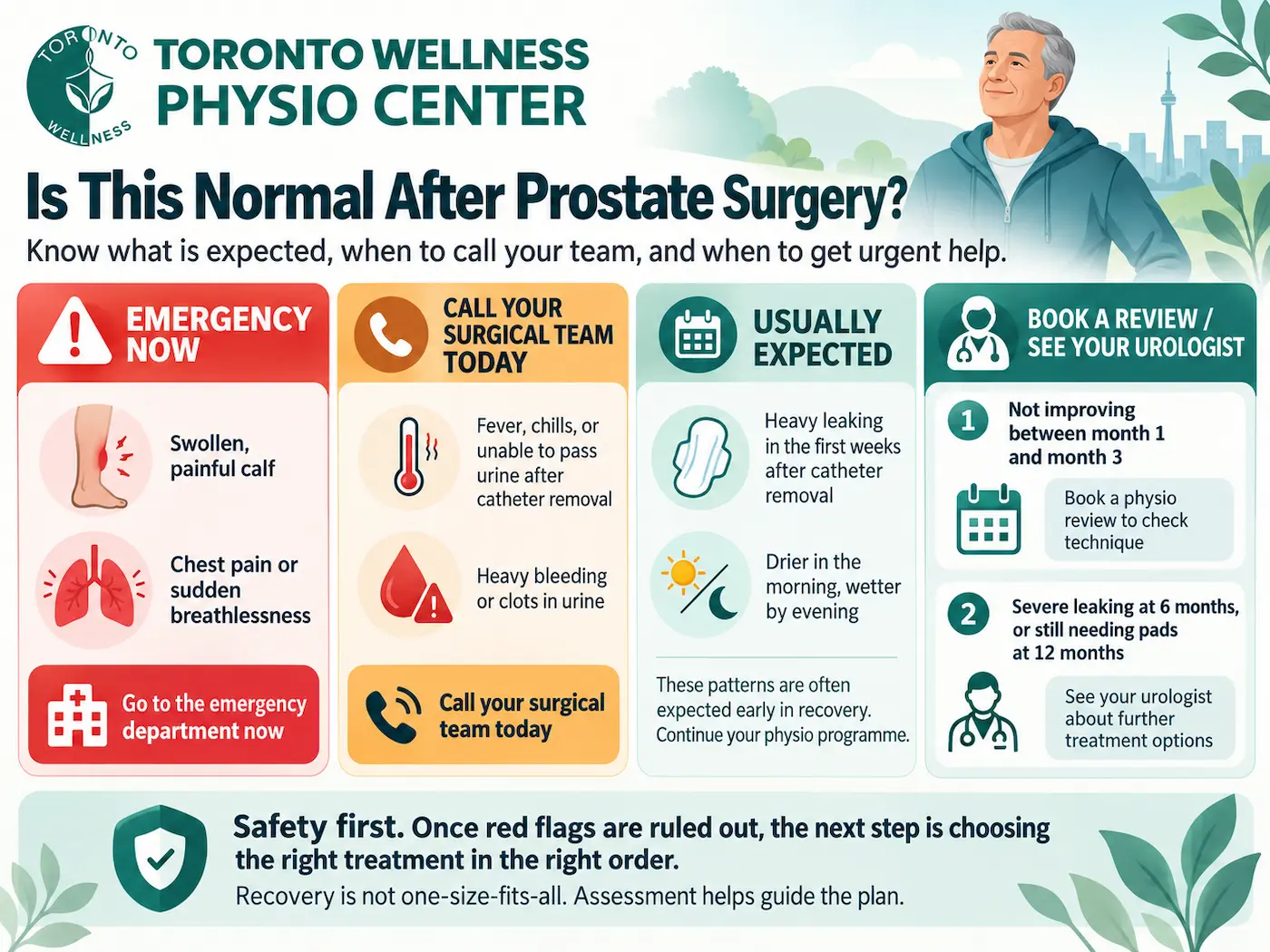
Is this normal, or should I call someone?
| What you notice | What to do |
|---|---|
| Fever, chills, or you cannot pass urine after the catheter is out | Call your surgical team today, or go to the emergency department |
| Swollen, painful calf, chest pain or sudden breathlessness | Emergency department now |
| Heavy bleeding or clots in your urine | Call your surgical team today |
| Heavy leaking in the first weeks after catheter removal | Expected; start or continue your physio programme |
| Drier in the morning, wetter by evening | Expected; a sign endurance is the next training target |
| Leaking not improving at all between month 1 and month 3 | Book a physio review to check your technique |
| Severe leaking at 6 months, or still needing pads at 12 months | See your urologist about further treatment options |
Once safety is covered, the practical decision is which treatments to use and in what order.
Physio compared with your other options
Pads and waiting: Pads protect you, and some recovery happens with time alone. The risk is not knowing whether you are on track until months have passed.
Penile clamp: A device that compresses the urethra from outside. It can help for short periods, such as a round of golf, but it needs to be used carefully and is not a long-term fix.
Male sling: A surgical option that supports the urethra, usually for mild to moderate leaking that has not settled.
Artificial urinary sphincter: An implanted cuff you open with a pump in the scrotum. It is the standard surgical option for more severe or persistent leaking, and guidelines ask urologists to discuss it with men who have ongoing stress leakage.
Physiotherapy: The first-line option recommended in guidelines, with no downside beyond time. It is also worth being honest about the evidence. A Cochrane review found conflicting results on how much therapist-taught pelvic floor training adds after radical prostatectomy, partly because the trials used very different programmes and measures [+]. Guidelines still recommend it because it can speed recovery, it is safe, and it keeps you monitored rather than waiting blind.
What the review cannot tell you is how you will personally respond, which is what an assessment is for.
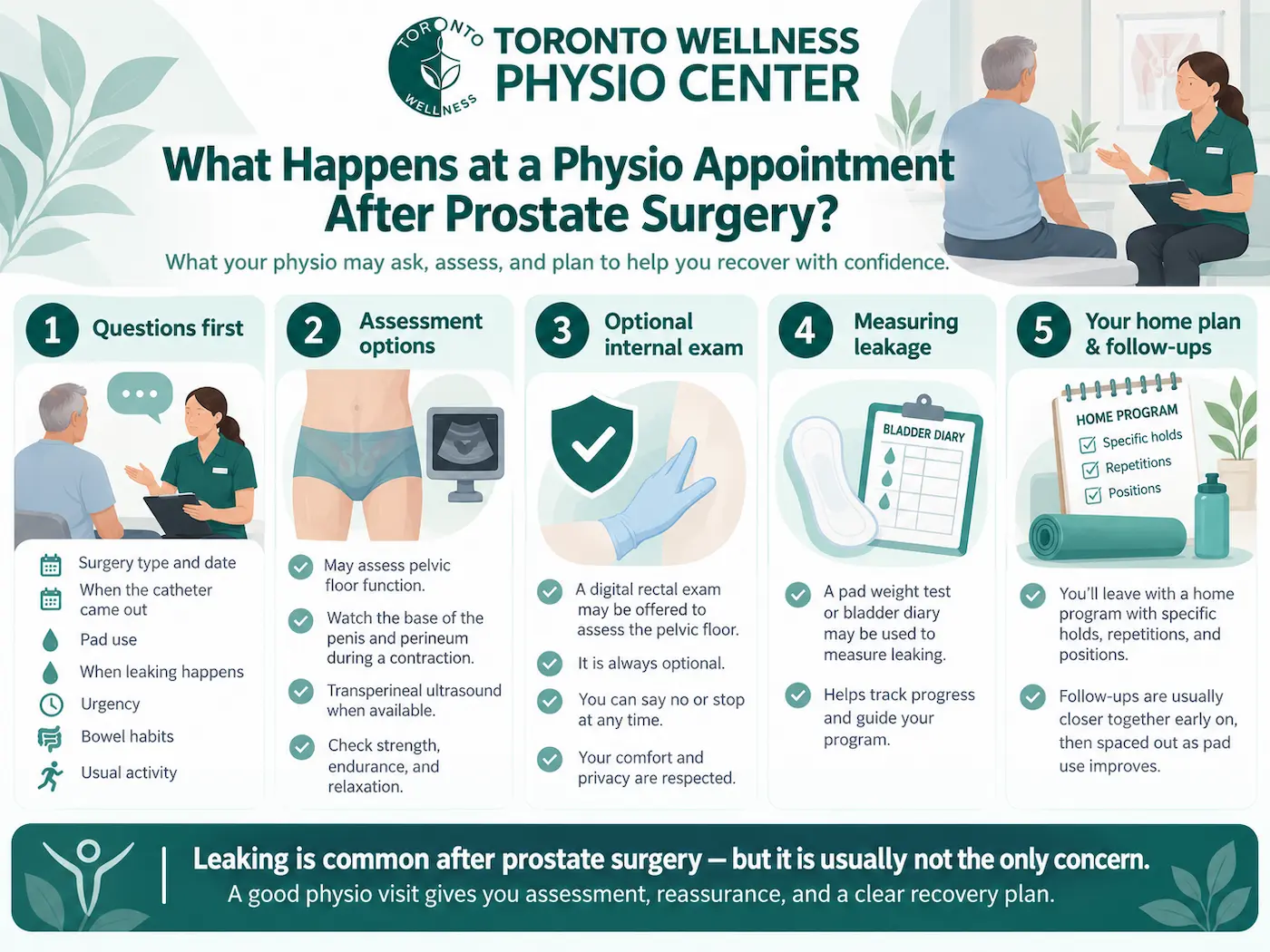
What happens at a physio appointment after prostate surgery
The first visit starts with questions: the type of surgery and its date, when the catheter came out, how many pads you use and how wet they are, when you leak, whether you have urgency, bowel habits and your usual activity.
The assessment may include:
- Watching the base of the penis and the perineum as you contract, which shows whether the urethral sphincter is working.
- Transperineal ultrasound, where available, placed on the skin between the legs to show the contraction on screen.
- A digital rectal examination to check strength, endurance and relaxation. This is always optional, and you can say no or stop at any time.
- A pad weight test or bladder diary to put a number on the leaking.
You leave with a programme for home: specific holds, repetitions and positions. Follow-ups are usually more frequent in the first few months and then spaced out as your pad count drops.
Leaking is the main reason men come in, but it is rarely the only question they have.
Sexual function, radiation and other questions
- Erections: Erectile recovery after prostatectomy is a separate process, managed with your urologist. The pelvic floor does contribute to erectile rigidity, so it is worth mentioning at your physio assessment, but physio is not a replacement for medical penile rehabilitation.
- Leaking during arousal or orgasm: This is common after prostatectomy and rarely talked about. Tell your physiotherapist and urologist, because it can be assessed and there are options.
- After radiation or TURP: The same assessment applies, although radiation can also irritate the bladder and add urgency, which changes the programme.
- Referral and cost in Ontario: You do not need a referral to see a physiotherapist privately, although some extended health plans ask for one before reimbursing. Many men having prostate surgery are over 65, and OHIP does fund physiotherapy for people 65 and older, but only at designated community clinics [+]. Ask whether a funded clinic offers male pelvic floor assessment before joining its waiting list.
What to do next
- If surgery is booked, arrange a pre-operative physio session to learn the right contraction.
- After the catheter comes out, count your pads every day.
- Book a physio assessment in the first few weeks, or at any point if progress stalls.
- Check in with your urologist if leaking is severe at six months or still present at twelve.
A note before you act on this
This article is general information, not medical advice for your recovery. Surgical techniques, catheter timing and post-operative instructions differ between surgeons, and your team’s instructions take priority over anything here. A physiotherapist can assess how your pelvic floor is actually working and build a plan around your surgery. You can book through Physiotherapy in Richmond Hill or Physiotherapy in North York. If you have a fever, cannot pass urine, see heavy bleeding, or develop calf swelling or breathlessness after surgery, contact your surgical team or go to the emergency department.
FAQ
When should I start physiotherapy after prostatectomy? Ideally before surgery, to learn the correct contraction. After surgery, most men start once the catheter is removed and their surgeon has cleared them. Starting in the first few weeks gives you the most time to influence recovery.
Is it normal to leak after prostate surgery? Yes. Most men leak when the catheter first comes out, and guidelines tell surgeons to prepare patients for this. For most men it improves close to baseline within 12 months.
How long does incontinence last after prostatectomy? It varies. Many men see big improvements in the first three months and are dry or nearly dry by 12 months. A minority still have bothersome leaking years later, which is why ongoing leakage at 12 months should be reviewed by your urologist.
Are Kegels enough after prostate surgery? Sometimes, but not always. The standard “hold in wind” cue mainly works the muscles around the anus. Cues such as “shorten the penis” or “stop the flow” reach the urethral sphincter more directly, and a physiotherapist can check you are using the right muscle.
How many physio sessions will I need? It depends on how much you leak and how quickly your technique settles. Some men need a handful of sessions; others need regular review over several months. Pad counts guide the schedule.
Do I need an internal exam? No. A rectal exam gives useful information about strength and relaxation, but it is always optional. External observation and ultrasound can be used instead.