
The quickest way to separate an ankle fracture vs sprain is not swelling or bruising, which both injuries cause. It is two things: whether pressing on specific points of bone hurts, and whether you can take four steps on the foot. Doctors in Canada use exactly these checks, called the Ottawa ankle rules, to decide who needs an X-ray.
Most twisted ankles are sprains, not breaks. A sprain is still a real injury, though, and how you treat it in the first six weeks decides whether it keeps giving way for years.
Go to the emergency department now if the ankle or foot looks deformed, bone is visible through the skin, or the foot is cold, pale, blue or numb. Those are not wait-and-see injuries.
Before you test anything, it helps to know what each injury actually is, because the names hide how much they overlap.
What a sprain is, what a fracture is, and what they get confused with
Ankle sprain: A stretch or tear of the ligaments that hold the ankle bones together. Most happen on the outside of the ankle when the foot rolls inward. Sprains are graded by how much of the ligament is torn, from a mild stretch to a complete tear.
Ankle fracture: A break in one or more of the bones that form the ankle joint, usually the lower end of the fibula (the outer bump) or the tibia (the inner bump). A break in the foot just below the ankle, such as the base of the fifth metatarsal on the outer edge, often comes from the same twisting injury.
What people often assume, and should not:
- “I can walk, so it’s not broken”: Some fractures still let you limp. Walking makes a break less likely, not impossible.
- “It’s black and blue, so it’s broken”: Heavy bruising is common with bad sprains too.
- “It’s only a sprain”: A sprain and a fracture can happen together, and a poorly rehabilitated sprain is one of the commonest causes of a chronically unstable ankle.
Three other injuries are regularly mistaken for an ordinary sprain: a torn Achilles tendon, a high ankle sprain (injury to the ligament joining the tibia and fibula above the joint), and a fracture of the fifth metatarsal. Each is covered below.
Why telling them apart matters
A displaced fracture that is treated as a sprain can heal out of position, and a joint that heals crooked wears faster. On the other side, a sprain that is immobilised for weeks out of caution recovers more slowly and is more likely to keep rolling.
That is why the decision rests on a tested rule rather than on how bad the ankle looks. In a systematic review of 27 studies and more than 15,000 patients, the Ottawa ankle rules picked up almost every fracture, and the authors estimated they could cut unnecessary X-rays by 30 to 40% [+]. The rules were developed in Ottawa and are now used in emergency departments worldwide.
Here is how the two injuries usually differ, symptom by symptom.
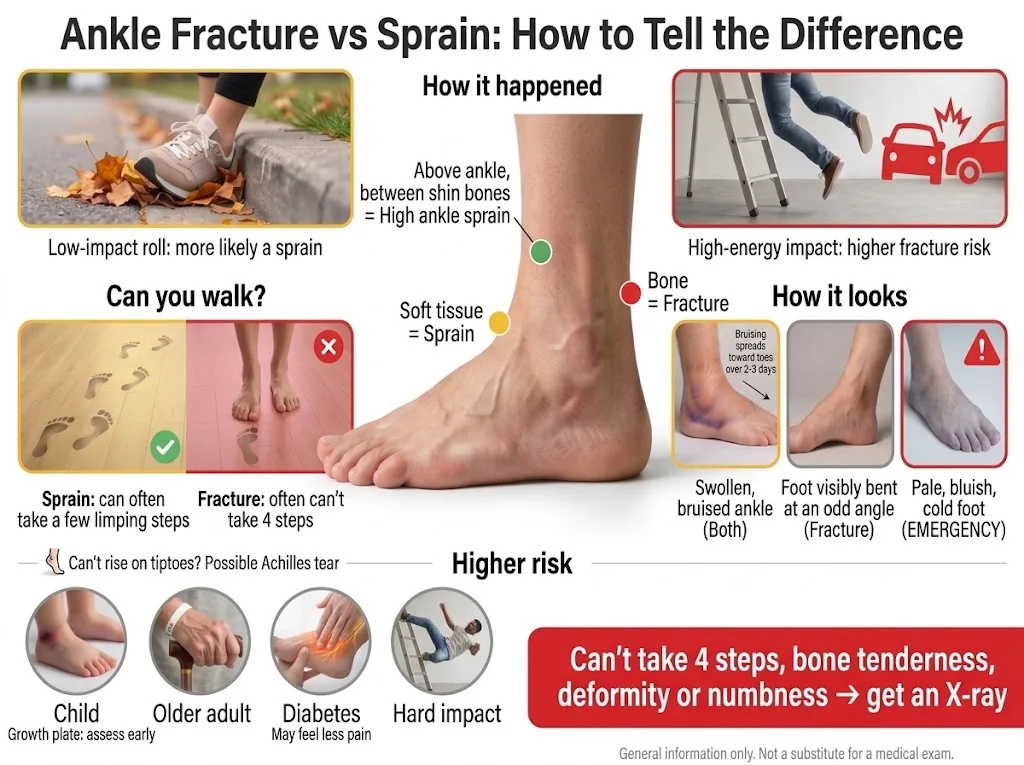
Ankle fracture vs sprain: signs grouped by what they tell you
How it happened
- Sprain: Rolling the foot inward on a curb, a hole, an uneven trail or someone else’s foot
- Fracture: The same roll with more force, a fall from height, a direct blow, or the leg twisting over a planted foot
- A loud crack is not reliable: ligaments can pop audibly too
- High-energy injuries (car accidents, falls from a ladder) raise the chance of a fracture
Where it hurts when you press
- Sprain: Tender over the soft area just in front of and below the outer ankle bone
- Fracture: Tender directly on bone, particularly along the back edge or tip of either ankle bone
- Foot fracture: Tender on the bump halfway along the outer edge of the foot (fifth metatarsal) or on the inner midfoot (navicular)
- Tenderness above the ankle, on the front of the shin where the two bones meet, points to a high ankle sprain
What you can do with it
- Sprain: Painful, but most people can take a few limping steps within the first hour
- Fracture: Often unable to take four steps at all, even limping
- Achilles tear: You may walk, but cannot rise onto the toes of that foot
- An ankle that keeps giving way days later suggests a significant ligament injury
How it looks
- Both: Swelling and bruising, often spreading down to the toes over two to three days
- Fracture: Visible deformity, or the foot sitting at an odd angle, means a fracture or dislocation until proven otherwise
- Circulation: A cold, pale or blue foot, or new numbness, is an emergency with either injury
Who it happened to
- Children: In growing children the growth plate near the ankle can be weaker than the ligaments, so a “sprain” in a child needs a lower threshold for assessment
- Older adults and people with osteoporosis: Fractures happen with less force
- People with diabetes or reduced sensation in the feet: A fracture may hurt less than expected, so pain is a poor guide
Signs tell you which way it leans. The next question is how quickly you need to act on it.
When an ankle injury needs an X-ray or the emergency department
The Ottawa ankle rules say an ankle X-ray is needed if you have pain around the ankle bones and any one of these: bone tenderness along the back edge or tip of the outer ankle bone (the lowest 6 cm), the same on the inner ankle bone, or an inability to take four steps both right after the injury and when you are examined. A foot X-ray is needed for midfoot pain with tenderness at the base of the fifth metatarsal or the navicular, or the same four-step test failed [+].
The rules are designed for clinicians, and they do not apply if you are intoxicated, have other painful injuries, are pregnant or have reduced sensation in your legs. Use them as a guide to how urgently to be seen, not as a self-diagnosis.
| What you notice | What it may mean | What to do |
|---|---|---|
| Deformed ankle, bone through the skin, or a cold, pale, blue or numb foot | Displaced fracture, dislocation or damaged blood supply | Call 911 or go to the emergency department now |
| Cannot take four steps, or pressing on the ankle or foot bones hurts | Possible fracture | Emergency department or urgent care for an X-ray the same day |
| A kick-like pop at the back of the heel; cannot rise onto your toes | Possible Achilles tendon tear | Emergency department or urgent care the same day |
| Pain above the ankle when you squeeze the shin bones together or turn the foot out | Possible high ankle sprain | Assessment within a few days |
| Can walk with a limp, tender only on soft tissue in front of the outer ankle | Likely ankle sprain | Physiotherapy assessment within a few days |
| Ankle keeps giving way weeks or months after a sprain | Chronic ankle instability | Book a physiotherapy assessment |
In Ontario, X-rays need a requisition from a doctor or nurse practitioner, which is why the fracture rows send you to emergency or urgent care rather than straight to a clinic.
Once a fracture is ruled out, the more common problem begins: treating a sprain properly.
Sprain vs fracture: how recovery differs
Ankle sprain: Most people walk normally within one to three weeks after a mild sprain, while moderate and severe sprains take several weeks to a few months before full sport. Current guidance favours early movement with a brace or tape over a cast. A clinical guideline in the British Journal of Sports Medicine recommends four to six weeks of functional support with exercise therapy, notes that ice, rest, compression and elevation on their own have not been shown to help, and reports that up to 40% of people develop chronic ankle instability after a sprain [+].
Ankle fracture: Treatment depends on whether the bones have shifted. A stable break may be managed in a walking boot, while an unstable one usually needs surgery with plates or screws. Bone takes roughly six to eight weeks to heal, and full strength, balance and confidence take months beyond that. If you had surgery, rehab follows your surgeon’s protocol, as in our post-surgical rehab program.
The two meet at the same place: a stiff, weak ankle with poor balance. That is what rehab rebuilds either way.
What happens at a physiotherapy assessment
You can book a physiotherapist directly in Ontario, with no doctor’s referral. If you have already had an X-ray, bring the report. If you have not, your physiotherapist will check for fracture first and send you for imaging if the rules point that way. A typical first visit includes:
- Fracture screen: The Ottawa ankle rules, plus checks for an Achilles tear and a high ankle sprain
- Ligament testing: Stability tests on the outer ankle ligaments, which are more accurate four to five days after the injury, once the swelling has started to settle
- Movement and strength: How far the ankle bends, calf strength and how you walk
- Balance: How long you can stand on the injured leg, compared with the other side
- A plan: Bracing or taping if needed, a home program for the stage you are in, and a review date
Later sessions build towards hopping, cutting and sport-specific drills. Before you return to running or pivoting sport, your balance and hop tests should be close to the uninjured side.
What you can do yourself after a sprain
These apply only once a fracture has been ruled out, either by an X-ray or by a clinician applying the rules.
- Keep weight on it: Walk as much as pain allows, using crutches for a few days if you are limping badly. Weight-bearing helps the ligament heal in a useful way.
- Use a brace, not a tensor bandage: A lace-up or semi-rigid ankle brace for the first four to six weeks, especially for sport and uneven ground.
- Move the ankle early: Trace the alphabet with your big toe, slowly, 2 or 3 times a day from the first few days. Stop short of sharp pain.
- Start balance work once you can stand comfortably: Stand on the injured leg for 30 seconds, 3 times, twice a day, near a counter for safety. Progress to eyes closed, then to a cushion.
- Strengthen the calf: Double-leg heel raises, 2 sets of 15, once a day, moving to single-leg raises when they are comfortable.
- Ice and elevation for comfort only: 15 to 20 minutes with a cloth between ice and skin can ease pain, but they are not a treatment plan on their own.
If pain or swelling is worse the morning after an exercise, drop back a level the next day rather than stopping.
Repeat sprains and the ankle that keeps rolling
A single sprain that is rested and never rehabilitated is the usual starting point for an ankle that rolls every few months. The ligament heals longer, the muscles react more slowly, and balance on that leg stays worse than on the other.
The fix is rarely more rest. A structured program of balance, strength and hop training, with a brace for sport during the first season back, is the first-line treatment. Surgery is considered only when a thorough exercise program has not worked.
What to do next
If the ankle passes the checks above (you can walk on it, and the bones are not tender) treat it as a sprain and start moving it within days. If it fails any of them, get an X-ray the same day before you do anything else.
Toronto Wellness & Physio Center sees ankle sprains and post-fracture rehab at both clinics. If your claim is through a car accident or work injury, or you want to check your benefits first, the front desk can confirm coverage before your first visit.
Frequently asked questions
Can you walk on a broken ankle?
Sometimes. Some fractures, especially small ones on the outer ankle bone, still allow a limp. Being able to walk makes a fracture less likely, but bone tenderness on the ankle or foot still means you need an X-ray.
How do I know if my ankle is sprained or broken without an X-ray?
You cannot be certain. The Ottawa ankle rules tell a clinician whether an X-ray is needed: tenderness on specific points of the ankle or foot bones, or being unable to take four steps, means it is. If neither applies, a fracture is very unlikely.
Is a bad sprain worse than a break?
It can be. A simple, stable fracture often heals fully in a few months, while a severe sprain that is not rehabilitated can leave the ankle unstable for years. Both need proper rehab.
Should I wrap a sprained ankle?
A lace-up or semi-rigid brace supports the ankle better than an elastic bandage. Wear it for the first four to six weeks, especially for sport, while you build strength and balance.
How long does a sprained ankle take to heal?
A mild sprain usually settles within one to three weeks. Moderate and severe sprains can take six weeks to a few months before full return to sport, depending on rehab.
What does a high ankle sprain feel like?
Pain sits above the ankle, at the front of the lower shin, rather than below the outer ankle bone. It often hurts more when you turn the foot outward and usually takes longer to recover than an ordinary sprain.
Before you act on any of this
This article explains how ankle injuries are usually told apart; it cannot examine your ankle. A sprain, a small fracture, a high ankle sprain and a torn Achilles can feel almost the same in the first few hours and need very different care, so a hands-on assessment is worth more than any checklist. Once a fracture has been ruled out, a physiotherapist can grade the sprain and give you a plan that lowers the chance of it happening again. You can book an assessment for physiotherapy in Richmond Hill or physiotherapy in North York. If the ankle is deformed, you cannot take four steps, or the foot is cold, pale or numb, go to the emergency department instead.