
Usually yes, but only if you hold a Blue Cross plan that includes physiotherapy. There is no automatic Blue Cross for seniors coverage in Ontario: Blue Cross here is a private insurer, and physio is paid only through a plan you buy, a retiree plan you move into when workplace benefits end, or a group plan through a spouse or former employer.
If you have none of these and you are 65 or older, you may not need one for physio at all. Ontario pays for physiotherapy for people 65 and over at clinics enrolled in a public program, at no cost to you.
This guide sorts out which of those situations you are in, what the plans typically pay, and how to get the most treatment out of a small benefit.
One thing first. If you have fallen and cannot put weight on a leg, or you hit your head while taking a blood thinner, go to the emergency department. Coverage can be sorted out afterwards.
Most of the confusion comes from the name itself. “Blue Cross” covers several different organizations and products, and only some of them pay for physio.
What “Blue Cross for seniors” means, and what it does not
In Canada, Blue Cross is a group of regional organizations, not one company. The Blue Cross that sells personal health plans in Ontario is a separate business from Alberta Blue Cross or Pacific Blue Cross in British Columbia, with its own plans and rules.
For an Ontario senior, Blue Cross coverage means one of these:
- A personal health plan: Bought directly, with or without medical questions.
- A retiree plan: Taken out when an employer’s group benefits end at retirement.
- A group plan: Through a spouse who is still working, a pension, a union or an association.
What it is not:
- Not OHIP: Blue Cross plans sit on top of provincial coverage. They do not replace it.
- Not a government seniors program in Ontario: Ontario has no “Blue Cross for seniors” program. Alberta does have one, the Coverage for Seniors program, which Alberta Blue Cross administers; its benefit list includes drugs, ambulance, clinical psychology and chiropractic, but physiotherapy is not on it [+].
- Not Medicare: If you live in the United States, Blue Cross Blue Shield Medicare plans follow Medicare rules, which this guide does not cover.
- Not travel insurance: A Blue Cross travel plan pays for emergencies outside the province. It will not pay for routine physio at home.
If you have a Blue Cross card in your wallet and are not sure which of these it is, the plan name on the card or your policy booklet will tell you.
Why two seniors with Blue Cross get different answers
Coverage is set by the plan, not by the insurer’s name or your age. Two people of the same age, both “with Blue Cross”, can have physio covered at very different levels, or one can have none.
Every plan answers the same four questions differently: what share of each visit it pays, whether there is a cap per visit, the yearly maximum for physiotherapy, and whether you need a doctor’s referral first. Our page on how extended health benefits pay for physiotherapy walks through how those four numbers interact.
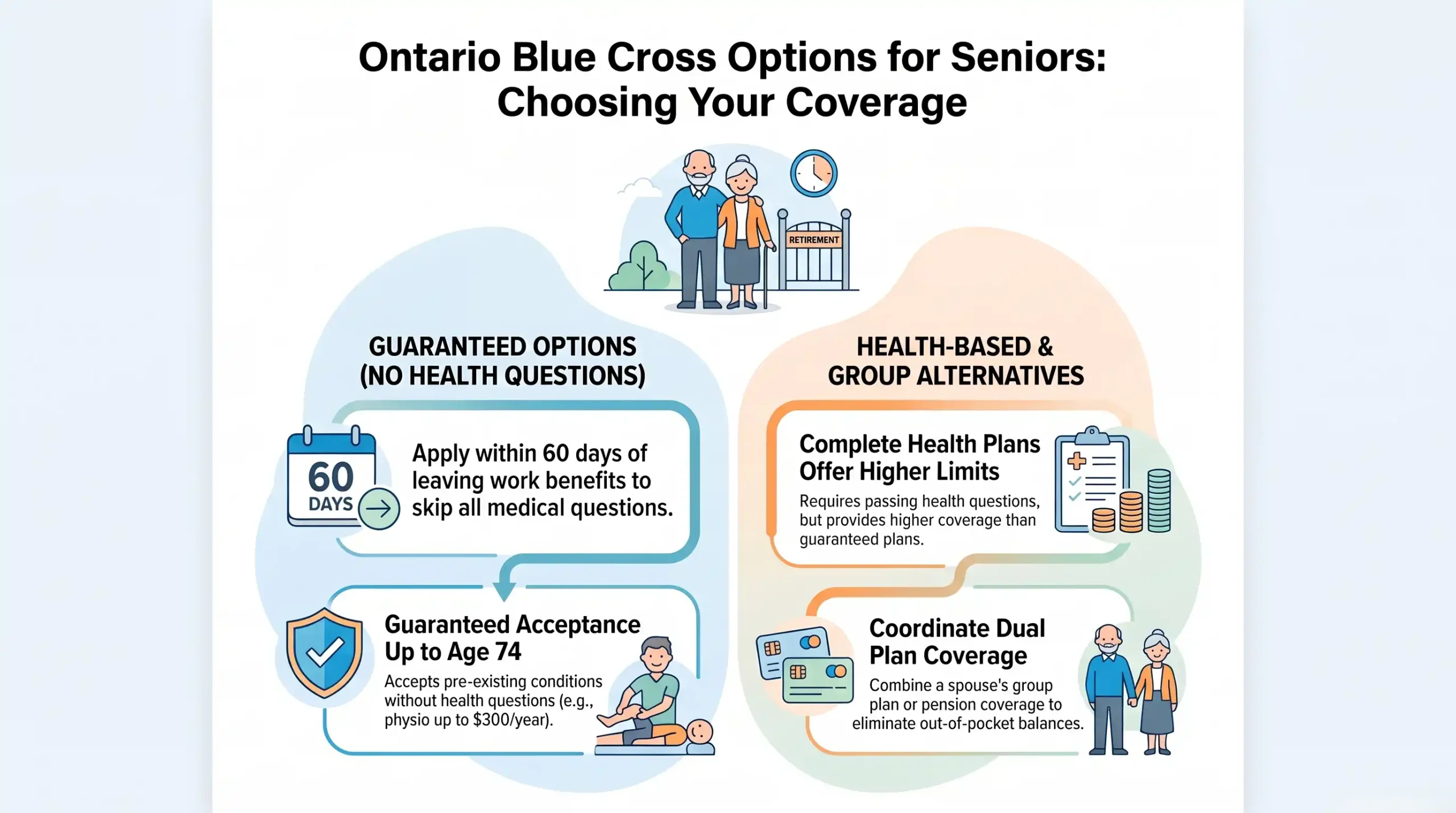
Personal plans tend to be leaner than the workplace plan you may be used to. One concrete example: Ontario Blue Cross’s Guaranteed Acceptance plan, which asks no medical questions, lists physiotherapy at 70% up to $300 per calendar year [+]. The same brochure notes that a physician’s referral is required for certain health benefits, so ask whether physio is one of them on your plan before you book.
Knowing that the plan decides everything, the useful next step is working out which kind of plan you actually have.
The Blue Cross plans Ontario seniors usually hold
Retiree plans
- Designed for people whose group benefits end when they retire.
- Ontario Blue Cross gives you 60 days after leaving workplace benefits to apply, with no medical questions inside that window [+].
- Offered in tiers (Silver, Gold, Platinum), and the higher tiers pay more for health practitioners such as physiotherapists.
- Miss the 60 days and you are back to plans that may ask health questions.
Guaranteed Acceptance
- No medical questions, and pre-existing conditions are accepted.
- Available up to age 74 [+].
- Physio at 70% up to $300 a year, as above. That is roughly three to four visits, depending on what your clinic charges.
Complete Health and other underwritten plans
- You answer health questions when you apply, and the plan can be adjusted to your budget.
- Paramedical services are included, with a yearly amount per practitioner category that rises with the tier.
- Worth comparing if you are healthy enough to qualify, since the practitioner amounts can be higher than on guaranteed plans.
Group coverage through someone else
- A working spouse’s plan often covers you as a dependant, usually at better levels than any personal plan.
- Some pensions, unions and professional associations offer Blue Cross group plans to retired members.
- If you have two plans, the clinic or the insurers can coordinate them so the second plan picks up part of what the first one leaves.
Plan types tell you where your coverage comes from. What you need right now is to know what to do about it this week.
Does Blue Cross cover physiotherapy for seniors? Your situation at a glance
| Your situation | Is physio covered? | What to do this week |
|---|---|---|
| Retiring, workplace benefits end soon | Yes, if you apply for a retiree plan in time | Apply within 60 days of your benefits ending, no medical questions |
| Personal Blue Cross plan already | Usually, at a fixed yearly amount | Find the physio line in your booklet: percentage, yearly maximum, referral |
| Covered on a spouse’s group plan | Usually, often at better levels | Ask the plan holder for the paramedical section of the benefits booklet |
| Blue Cross travel plan only | No, not for physio at home | Look at the public program below, or a personal health plan |
| No Blue Cross, 65 or older | Not through Blue Cross | Check OHIP-funded physio at an enrolled clinic, at no cost to you |
The last row is the one many people miss, and for some readers it makes the whole Blue Cross question unnecessary.
Blue Cross versus OHIP-funded physiotherapy at 65 and over
Ontario pays for physiotherapy for people 65 and older with a valid health card, through community clinics enrolled in the public program. The same program covers people 19 and under, people of any age after an overnight hospital stay or day surgery in the past 12 months, and people on Ontario Works or ODSP. There is no fee if you are eligible, and you contact a participating clinic directly to book [+].
So why would a senior pay for a Blue Cross plan, or use one they already have, for physio?
- Choice of clinic: OHIP-funded care is available only at enrolled clinics. Blue Cross lets you go to any registered physiotherapist who bills the plan.
- Appointment format: Private clinics usually offer one-to-one sessions with the same physiotherapist each visit. Format in the public program varies by clinic, so ask before you start.
- Timing: Private clinics often have same-week or same-day availability. Public program availability depends on the clinic and the time of year.
- Cost: Public care costs you nothing. Blue Cross reimburses part of a private fee, up to the plan’s yearly limit, and you pay the rest.
To be straightforward about our own position: we are a private clinic and we are not enrolled in the public program. If cost is what decides it for you, check the public program first. Many patients choose private treatment for the timing and the one-to-one format, and use their Blue Cross benefit to bring the cost down.
The two are not mutually exclusive either. Some people start in the public program and move to private care, using their plan, when they want more frequent sessions.
What happens when you use Blue Cross at a physio clinic
Most of the paperwork can be handled before you arrive. At a clinic that bills Blue Cross directly, it usually goes like this:
- Before the visit: You give the front desk your plan and member number. They check what the plan pays for physio and whether it needs a referral.
- At the visit: The clinic submits the claim. Blue Cross pays its share to the clinic and you pay only the difference.
- If the clinic cannot bill your plan directly: You pay in full, keep the receipt, and submit it to Blue Cross yourself, online or by mail.
- At tax time: What you paid out of pocket to a registered physiotherapist can generally be claimed as a medical expense on your tax return. Keep every receipt.
Your first appointment is an assessment. Your physiotherapist will ask about your health history, medications and any falls, test your strength, balance and walking, and set a plan that fits both your goals and the number of visits your coverage realistically allows. For a full picture of what that care looks like, see our page on geriatric physiotherapy.
Making a small physio benefit go further
A $300 benefit at 70% sounds thin, and at full weekly visits it is. Here is the arithmetic, using a $100 visit only to keep the numbers simple: the plan pays $70 and you pay $30. After four visits the plan has paid $280. On the fifth it pays the last $20, and from then on you pay in full until the calendar year resets.
Four visits can still do a lot if they are used well. What tends to work:
- Front-load the assessment, then space visits out: One assessment, then visits every two to three weeks to check progress and update your program, rather than four visits in a month.
- Make the home program the treatment: For most older adults working on strength and balance, the exercises you do between visits matter more than the visits themselves. Exercise programs reduce the rate of falls in older people living in the community by about 23%, and programs built mainly on balance and functional exercises do as well [+].
- Ask for a written, dosed program: A typical starting program, once your physiotherapist has assessed you, looks something like sit-to-stands from a firm chair, 2 to 3 sets of 8 to 10, every second day, with mild muscle fatigue that settles by the next morning. Yours may differ. The point is to leave with numbers, not “do these regularly”.
- Use the year boundary: Benefits usually reset each calendar year. If you need a block of treatment in late autumn, some visits can fall in December and some in January.
- Stack your coverage: If you are 65 or older, the public program and a private benefit can be used at different points in the same year.
What does not stretch a benefit: saving visits for “when it gets really bad”. A short course of treatment early, while a problem is still small, usually needs fewer visits than one that starts after months of avoiding the stairs.
Retiring soon? The 60-day window matters most
If you are still working, this is the part to act on. Workplace benefits usually end on your last day or at the end of that month, and the retiree plan window starts counting from there.
Inside the 60 days, Ontario Blue Cross’s retiree plans ask no medical questions. Outside it, you may have to qualify on health grounds, and someone with a knee replacement on the horizon or a history of back trouble may find the choice narrower or the price higher.
Three practical steps before your last day:
- Book any physio, dental or vision care you need while your workplace plan still pays.
- Ask HR the exact date your benefits end, in writing.
- Get a retiree plan quote and compare the physio amount in each tier with what you used last year.
What to do next
Start with the card in your wallet. If it is a Blue Cross health plan, find the physiotherapy line in your booklet, or let a clinic’s front desk check it for you. If you only have travel coverage and you are 65 or older, look at the public program. If you are about to retire, the 60-day window is the one deadline in this whole subject that cannot be fixed later.
Whichever route you take, the assessment is the same first step. It tells you how many visits your problem actually needs, which is the number to compare against what your plan pays.
Before you act on any of this
This article is general information, not a reading of your policy and not an assessment of your health. Plans change from year to year, and two people with the same plan name can have very different coverage, so your own booklet or a call to Blue Cross is the final word on what you can claim. Coverage only answers how a visit gets paid; a physiotherapist who has examined you can tell you how many visits you actually need and what you can safely do at home in between. You can book an assessment for physiotherapy in Richmond Hill or physiotherapy in North York, and our front desk will check your coverage before you come in. If you have had a fall and cannot bear weight, or hit your head while on a blood thinner, go to the emergency department.
Frequently asked questions
Does Ontario Blue Cross cover physiotherapy for seniors?
Yes, on plans that include paramedical benefits, which most of its personal and retiree plans do. The amount depends on the plan. The Guaranteed Acceptance plan, for example, lists physiotherapy at 70% up to $300 per calendar year. Ontario has no separate Blue Cross program for seniors.
Is physiotherapy free for seniors in Ontario?
It can be. If you are 65 or older and have a valid Ontario health card, you can receive physiotherapy at no cost at a clinic enrolled in Ontario’s community physiotherapy program. Private clinics that are not enrolled charge a fee, which extended health plans such as Blue Cross can partly cover.
Do I need a doctor’s referral to use Blue Cross for physio?
It depends on your plan. You do not need a referral to see a physiotherapist privately in Ontario, but some insurance plans require one before they reimburse certain benefits. Check your booklet or ask the clinic to confirm before your first visit.
Can I get Blue Cross after I retire if I have health problems?
If you apply for a retiree plan within 60 days of your workplace benefits ending, Ontario Blue Cross asks no medical questions. After that window, the Guaranteed Acceptance plan still accepts pre-existing conditions with no medical questions, up to age 74, at lower benefit levels.
Does Blue Cross travel insurance cover physiotherapy?
Not for ongoing physio at home. Travel medical insurance is designed for emergencies while you are outside the province. Physio after an injury abroad may be covered only in specific circumstances described in the policy.
Can I use Blue Cross and OHIP-funded physio in the same year?
Yes. They are separate systems. Public physio is delivered at enrolled clinics at no cost, while Blue Cross reimburses private visits up to your plan’s limit. Many seniors use both at different points in the year.