
The mistakes that set people back after ACL reconstruction are rarely dramatic. Most are small: a pillow under the knee, a skipped set of quad exercises, a pickup game at month five because the knee “feels fine”. This guide covers what not to do after ACL surgery, sorted by what each mistake actually damages and by the phase of recovery where it does the most harm.
One thing first. If you have calf pain, calf swelling or tenderness, chest pain, or sudden shortness of breath in the weeks after surgery, call 911 or go to the nearest emergency department. Those can be signs of a blood clot, and they are not something to mention at your next physio visit.
Most people who follow their surgeon’s instructions and keep up with rehab recover well. The aim here is to keep you in that group.
Before the list, it helps to know what you are protecting. Every rule below exists to guard one of four things.
What the “don’ts” are actually protecting
ACL reconstruction replaces your torn ligament with a graft, usually taken from your hamstring, patellar tendon or quadriceps tendon. The surgery fixes the structure. Rehab rebuilds everything around it.
In the first months, recovery depends on four things:
- The graft: It goes through a remodelling phase after surgery and is not at full strength for many months, even when the knee feels normal.
- Full extension: The ability to straighten the knee completely, as far as the other side.
- Quadriceps control: The thigh muscle switches off after knee surgery and has to be retrained deliberately.
- The wound and your circulation: Infection and blood clots are uncommon, but they are the complications that need urgent action.
What the list is not: a substitute for your surgeon’s protocol. If you had a meniscus repair or another procedure at the same time, your limits on weight bearing, bending and bracing may be stricter than anything written here, and your surgeon’s instructions win.
Why small mistakes have long consequences
Knee straightening is the clearest example of how an early shortcut becomes a long-term problem. A knee that will not fully straighten makes you walk with a slight bend, which overloads the front of the knee and keeps the quadriceps weak.
The window for fixing it is short. In one study of ACL reconstruction patients, extension range at 4 weeks was related to extension loss at 12 weeks, and the authors cite earlier work linking loss of normal knee motion to a higher rate of osteoarthritis on X-ray years later [+]. A few degrees lost in the first month can be hard to get back.
The same pattern runs through the rest of recovery. With that in mind, here is what to avoid, grouped by what each mistake puts at risk.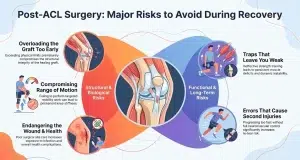
What not to do after ACL surgery, by what it puts at risk
Mistakes that cost you range of motion
- Do not put a pillow or rolled towel under your knee when you lie down. It feels comfortable and it trains the knee to stay bent.
- Do not sleep with the knee bent for hours at a time in the first weeks.
- Do not skip your extension work (heel props, for example) because it aches. Mild stretching discomfort is expected. Sharp pain is not, and needs a call to your physio.
- Do not wait for swelling to “go down on its own” before you start moving. Swelling and stiffness feed each other.
Mistakes that overload the graft too early
- Do not pivot, twist on a planted foot, cut, jump or land until your physio has progressed you to it. Rotation under load is the movement the ACL controls.
- Do not do full-range leg extensions on a machine in the first two months unless you have been told to. One widely used guideline allows open-chain quadriceps work from week 4, but only in a limited range (90 to 45 degrees of bend), widening gradually to full range by about week 8 [+].
- Do not return to a gym program or class you did before the injury without checking which exercises are cleared.
- Do not breaststroke kick or swim with fins until your physio clears it. Light walking in the pool is a different matter once the wound has healed.
- Do not stop wearing a prescribed brace early, or start wearing one you were not given. Many surgeons do not use bracing after a straightforward reconstruction. If yours did, there is usually a reason, often a meniscus repair.
Mistakes that risk the wound or your health
- Do not soak the knee in a bath, hot tub, pool or lake until the incisions are fully closed and your surgeon has said so. Showering with the dressing covered is usually fine.
- Do not ignore a fever above 38°C, spreading redness, wound discharge or pain that is getting worse instead of better. Contact your surgeon the same day, or go to emergency if you cannot reach them.
- Do not ignore calf pain or swelling, chest pain or breathlessness. That is the 911 situation described at the top of this page.
- Do not drive while you are taking opioid pain medication, whichever knee was operated on.
Mistakes that leave you weak
- Do not skip quadriceps activation exercises in the first days. Quad sets (tighten the thigh, press the back of the knee down, hold for 5 to 10 seconds, 10 repetitions, several times a day) are dull and they matter.
- Do not rely on the knee “getting stronger by walking”. Normal daily activity does not load the quadriceps enough to rebuild it.
- Do not miss physio sessions in the first six weeks. That is where range and quad control are won or lost.
- Do not neglect the other leg, your hips and your trunk. They all feed into how well the operated knee is protected later.
Mistakes that cause a second injury
- Do not return to pivoting sport (soccer, basketball, skiing, hockey) because a date on the calendar has passed.
- Do not treat “it feels fine” as a test result. Feeling ready and testing ready are different things, covered below.
- Do not play through a giving-way episode, a sudden new swelling, or a knee that locks or will not fully straighten. Each of these needs to be assessed.
Categories tell you what is at stake. What most people want to know is which of these matters right now, in the week they are in.
What not to do at each stage of ACL recovery
Timelines vary with the graft, any additional procedures and your surgeon’s protocol. Treat these ranges as typical, not fixed.
| Stage | Typical timing | The mistake to avoid | What to do instead |
|---|---|---|---|
| Protection | Weeks 0 to 2 | Pillow under the knee; soaking the wound; ignoring calf pain | Keep the knee straight at rest, elevate, quad sets several times a day |
| Early restoration | Weeks 2 to 6 | Letting extension slip; walking with a bent knee | Match the other knee’s extension by about week 4; normalise walking |
| Strengthening | Weeks 6 to 12 | Full-range leg extensions or jumping too soon | Progressive strength work on your physio’s schedule |
| Building capacity | Months 3 to 6 | Running, pivoting or sport because the knee feels good | Running only when cleared; continue heavy strength work |
| Return to sport | Month 9 onward | Going back on a date rather than on test results | Pass a strength and hop test battery before contact or pivoting sport |
If your knee sits behind the stage your calendar says you should be at, that is a reason to talk to your physio, not to skip ahead.
Feeling ready versus being ready to return to sport
Most second ACL injuries happen in a knee that felt fine. That gap between how the knee feels and what it can tolerate is the reason the return-to-sport decision should rest on testing.
The clearest data come from a Norwegian cohort of patients returning to pivoting sport after reconstruction. The reinjury rate dropped by 51% for each month that return to sport was delayed up to 9 months after surgery, with no further benefit after that point. Of the patients who failed return-to-sport criteria, 38.2% reinjured their knee, compared with 5.6% of those who passed, and more symmetrical quadriceps strength before returning lowered the risk [+].
So two things have to be true before you return to pivoting sport: enough time has passed, and you have passed the tests. Practice guidelines generally set the bar at 90% or more of the uninjured leg’s strength and hop performance, and higher for contact and pivoting sports [+]. Nine months is a minimum, not a finish line.
That testing is part of what a structured rehab program does. Here is what the clinic side of recovery looks like.
What happens at physiotherapy after ACL surgery
Your first visit usually happens within the first week or two, depending on your surgeon. Expect your physiotherapist to:
- Read your surgical report and protocol, including graft type and any meniscus or cartilage work
- Measure your extension, bend and swelling, and test whether your quadriceps can lift a straight leg without a lag
- Check your walking and teach you the home exercises for the phase you are in
- Set the criteria for moving to the next phase, so progress is based on what your knee can do
Later sessions shift towards strength, balance and control, and then to running, jumping and sport-specific work. Near the end, a test battery (strength, single-leg hops, movement quality) gives you and your surgeon an objective basis for the return-to-sport decision.
We work alongside your surgeon throughout. If something looks off, such as extension that will not come back or swelling that keeps returning, we refer you back rather than pushing through it.
What you can do yourself between sessions
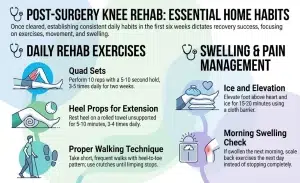
These apply once your surgeon and physio have cleared you for a home program. They are the habits that most change how the first six weeks go.
- Quad sets: 10 repetitions with a 5 to 10 second hold, 3 to 5 times a day in the first two weeks.
- Heel props for extension: Heel on a rolled towel, knee unsupported, 5 to 10 minutes, 3 to 4 times a day. Mild stretch discomfort is normal; it should settle within an hour.
- Ice and elevation: 15 to 20 minutes at a time, with a cloth between ice and skin, foot above the level of your heart. Cold helps with pain mainly in the first week [+]; elevation and movement do more for swelling.
- Walking: Short, frequent walks with a normal heel-to-toe pattern and the knee straightening fully at heel strike. Use crutches until you can walk without a limp.
- Swelling check: If the knee is noticeably more swollen the morning after a session or exercise, you did too much. Scale back the next day rather than stopping altogether.
Driving, work and travel after ACL surgery
These are the questions people ask most after the first week, and the answers depend on which knee was operated on.
- Driving: If your left knee was operated on and you drive an automatic, you may be able to drive sooner, once you are off opioid medication and can get in and out of the car comfortably. After right knee surgery, most people need several weeks, and you need to be able to brake hard without hesitation. Ask your surgeon before you drive, and check that your insurer has no conditions.
- Desk work: Often possible within one to two weeks, with the leg elevated when you can.
- Physical or on-your-feet work: Usually several months, depending on the job. If the injury happened at work, your WSIB claim affects how return to work is planned.
- Flights: Long flights in the early weeks raise clot risk. Ask your surgeon before booking.
In Ontario, anyone who has had outpatient or day surgery in the last 12 months may qualify for government-funded physiotherapy at a participating community clinic, for a condition that needs physiotherapy [+]. Most ACL reconstructions are day surgery, so it is worth asking about. Many people combine it with extended health benefits for the longer later phases.
What to do next
If you have just had surgery, the priorities for the next two weeks are short: keep the knee straight at rest, get your quads working, protect the wound and know the warning signs. If you are further along, the question that matters is whether your progress is based on how the knee feels or on how it tests.
Toronto Wellness & Physio Center offers knee pain treatment and structured rehab after reconstruction at both clinics, and can work from your surgeon’s protocol from the first week.
Frequently asked questions
How long after ACL surgery can I walk without crutches?
Most people walk without crutches somewhere between 1 and 4 weeks, once they can walk without a limp and the knee straightens fully. A meniscus repair at the same time can delay this, because weight bearing may be restricted for several weeks.
Is it bad to bend my knee too much after ACL surgery?
Gentle bending within your protocol is encouraged. Forcing deep bending early, or bending against heavy load, is what to avoid. In the first weeks, losing straightening is the more common and more serious problem than limited bending.
Can I damage my ACL graft in the first few weeks?
It is uncommon with normal daily activity and a prescribed exercise program. The risk comes from pivoting, twisting, falls and jumping, which is why those are restricted. If you feel the knee give way or swell suddenly, contact your surgeon or physiotherapist.
When can I sleep on my side after ACL surgery?
Most people can sleep on their side once the early pain settles, usually within the first one to two weeks, with a pillow between the knees. Avoid sleeping with the operated knee bent for long periods.
When can I run after ACL surgery?
Running usually begins around 3 to 4 months, but it should depend on criteria such as full extension, no swelling after activity and adequate quadriceps strength, not on the date alone. Your physiotherapist can test this.
Is 9 months always enough before returning to sport?
No. Nine months is the point after which further waiting stopped reducing risk in the research, but it is a minimum. You also need to pass strength and hop testing before returning to pivoting or contact sport.
Before you act on any of this
This article is general information, not an assessment of your knee. Two people at the same week after surgery can have very different grafts, additional repairs and protocols, and advice that suits one can set the other back. A clinician who has examined your knee and read your surgical report can tell you which of these rules apply to you and when they change. You can book an assessment for physiotherapy in Richmond Hill or physiotherapy in North York. If you develop calf pain or swelling, chest pain or shortness of breath, call 911 or go to the emergency department.