
Massage therapy direct billing means the clinic sends your claim to your insurer while you are still at the front desk, and you pay only the part your plan does not cover. You skip the full upfront payment and the wait for a reimbursement cheque.
What it does not do is increase your coverage. If your plan pays 80% up to $500 a year, it pays exactly that whether the clinic bills it or you do. Knowing that, and knowing the handful of things that can make a direct claim fail, saves most of the surprises people run into.
Booking a massage in Richmond Hill? Our massage therapy team can check your coverage when you book, so you know your share before the appointment.
What direct billing changes, and what it does not
The two ways of paying lead to the same result for your benefits, because the plan’s rules decide what gets paid. If those rules are new to you, start with how extended health plans work. The two methods differ only in who carries the money in between.
With pay-and-claim, you pay the full fee, submit the receipt yourself and wait to be reimbursed. With direct billing massage therapy, the clinic submits the claim electronically, your insurer answers within seconds in most cases, and you pay the balance on the spot. As Manulife puts it, the provider can “submit the claim on your behalf, and you only pay the portion not covered by your benefits plan” [+].
Direct billing is not:
- Extra coverage: Your percentage, per-visit cap and annual maximum stay the same.
- A guarantee: The insurer can still decline the claim, or audit it months later.
- The route for every injury: Car accident and workplace injury treatment is billed through separate systems in Ontario (more on that below).
How a direct-billed massage claim moves
Most clinics in Ontario send claims through TELUS Health eClaims or an insurer’s own provider portal. The network connects to more than 30 insurers, and many claims are adjudicated automatically, with an answer on coverage and provider eligibility while you wait [+].
In practice, it runs in four steps:
- You give the front desk your insurer, plan or policy number, and member or certificate number. If you are claiming under a spouse’s plan, they need the plan member’s name and date of birth.
- After your treatment, the clinic submits the claim with the treatment length and your therapist’s registration number.
- The insurer replies: approved in full, approved in part, or declined.
- You pay whatever is left and take your receipt, which shows what the insurer paid and what you paid.
Steps two to four usually take less than a minute. When they do not, it is almost always for one of the reasons below.
Why a direct billing claim gets declined
A declined claim at the desk has a cause, and the clinic’s screen normally shows it. Six causes cover nearly all of them.
| What happened | What you can do |
|---|---|
| Annual maximum already used | Pay the session; keep the receipt for your tax return |
| Your plan requires a doctor’s referral | Get the referral, then submit the receipt yourself |
| Member number or birth date does not match | Check your benefits card or app and resubmit |
| The claim is for a second plan (yours already paid) | Submit the balance to the second plan yourself |
| Your insurer is not connected to the clinic’s system | Pay and claim online; most insurers pay within a week |
| The therapist or clinic is not accepted by your insurer | Ask the clinic before booking again |
The referral row deserves a closer look. Some workplace plans will not pay for massage without a physician’s note, even though you do not need one to see an RMT in Ontario.
Why the therapist’s registration matters in Ontario
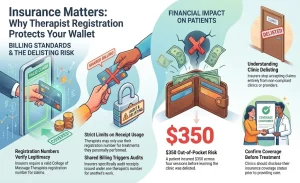
Your insurer pays for massage from registered massage therapists, and in Ontario that means a current member of the College of Massage Therapists of Ontario. The registration number on the claim is how the insurer checks.
The College’s billing standard is strict about this. An RMT may put “massage therapy treatment” and their registration number only on services they personally provided, and may not submit a charge they know to be false or misleading [+]. A receipt issued under one therapist’s number for another person’s work is exactly what insurers audit for.
There is a practical reason to care as a patient. When an insurer finds billing problems, it can stop accepting claims from a provider or clinic altogether, a step known as delisting. The College of Physiotherapists of Ontario has described a patient who attended four physiotherapy sessions, $350 in total, before learning the insurer had stopped covering that clinic six months earlier [+]. That case involved physiotherapy, but the same thing can happen with massage. A clinic should tell you before treatment, not after.
Two plans, a car accident or a work injury
Direct billing handles the simple case best: one patient, one workplace plan, one claim.
Two plans in the household: In most cases only the first plan is billed directly. The rest of the balance goes to the second plan as a claim you submit yourself, with the first plan’s statement attached.
A car accident: In Ontario, treatment after a collision is normally billed to the auto insurer under accident benefits, not your workplace plan. See how motor vehicle accident claims work at our clinic.
A work injury: If the injury happened at work, the claim belongs with WSIB. Our page on workplace injury claims explains that process.
Five questions to ask before you book
When you are comparing massage therapists that do direct billing, a two-minute phone call answers almost everything:
- Do you direct bill my insurer for massage, and not just for physiotherapy?
- Is the therapist I am booking registered with the College, and will their number be on my receipt?
- Has my insurer ever declined or stopped accepting claims from your clinic?
- If the claim is declined at the desk, what do I pay today?
- Can you bill my spouse’s plan if mine is used up?
Pay attention to the third answer. If it is vague, book somewhere else.
If your clinic cannot bill your insurer
Nothing about your coverage changes. You pay the session, ask for an itemized receipt and claim it through your insurer’s app or website. Budget five minutes.
Frequently asked questions
Does direct billing cost more than paying up front?
It should not. The session fee is the same either way; direct billing only changes when the insurer’s share is paid and by whom.
Can the clinic direct bill my spouse’s plan?
Often, yes, if your spouse’s plan covers you as a dependant and the insurer is connected. The clinic will need your spouse’s plan details and date of birth.
Do I still get a receipt?
Yes. Keep it. Insurers can audit claims after paying them, and the part you paid yourself may count toward the medical expense credit, explained in our guide to whether massage therapy is tax deductible.
What if a claim is approved and then audited?
The insurer may ask you to confirm the visit or provide a receipt. Manulife, for example, asks members to keep receipts for 12 months after submitting. If you attended the session and your receipt is accurate, an audit is routine.
Which insurers can be billed directly?
At our clinic, direct billing for massage is available with major insurers including Sun Life, Manulife, Canada Life, GreenShield, Desjardins and Blue Cross. If your plan is with Equitable Life or another insurer that is not listed, call ahead: in some cases you will need to submit the claim yourself.
Before you book
This article is general information about how billing works at most Ontario clinics. Plans differ, and only your plan booklet or insurer can confirm what you are covered for. The same goes for your body: if you are booking massage for pain that has not been assessed, an assessment first makes sure massage is the right treatment and gives your insurer a clearer record. You can arrange one at our clinics for physiotherapy in Richmond Hill or physiotherapy in North York, and the front desk can confirm your coverage at the same time.