
If you have done Kegels for months and still leak when you sneeze, the exercises were probably not the problem. The match was. Pelvic floor therapy for urinary incontinence is a supervised programme, led by a physiotherapist, that treats the reason you leak: muscles that are weak, muscles that never let go, contractions that come a fraction of a second too late, or a bladder that sends urgent signals too early. For the most common types of leaking, it is the recommended first treatment, ahead of medication or surgery.
One exception before anything else. New leaking together with numbness between your legs, new leg weakness, or trouble passing urine is an emergency: go to the emergency department, not a physiotherapy clinic.
This guide covers what therapy does for stress, urge and mixed leaking, why exercising from a leaflet so often stalls, and what a realistic three-month course looks like in Ontario.
Your first visit starts with how your pelvic floor contracts and relaxes, so the programme you leave with is built for your type of leak rather than copied from a handout.
Most people arrive at this therapy believing it is a fancier name for Kegels. That belief is the main reason it gets tried badly, so it is worth being exact about what the treatment involves.
What pelvic floor therapy is, and what it is not
Your pelvic floor is a layer of muscle stretching from the pubic bone to the tailbone. It holds the bladder, bowel and (in women) the uterus in place, and it squeezes the urethra shut when pressure in your abdomen rises. When it is weak, overtight or badly timed, urine escapes.
Pelvic floor physiotherapy is the assessment and retraining of that system. A registered physiotherapist with pelvic health training checks how the muscles contract, how well they relax, how long they can hold and how quickly they react. Then you get a programme that may combine muscle training, relaxation work, bladder training and changes to habits like fluid intake and straining on the toilet.
What it is not:
- A photocopied page of Kegel instructions. Supervision is the treatment, not an optional extra.
- Always about strengthening. Some people leak because their muscles are clenched all the time and need to learn to release first.
- A substitute for a medical check when you have blood in your urine, signs of infection or trouble emptying your bladder.
- Only for women after childbirth. Men after prostate surgery, runners, people in menopause and older adults all use it.
If supervision is the difference, the next question is what goes wrong without it.
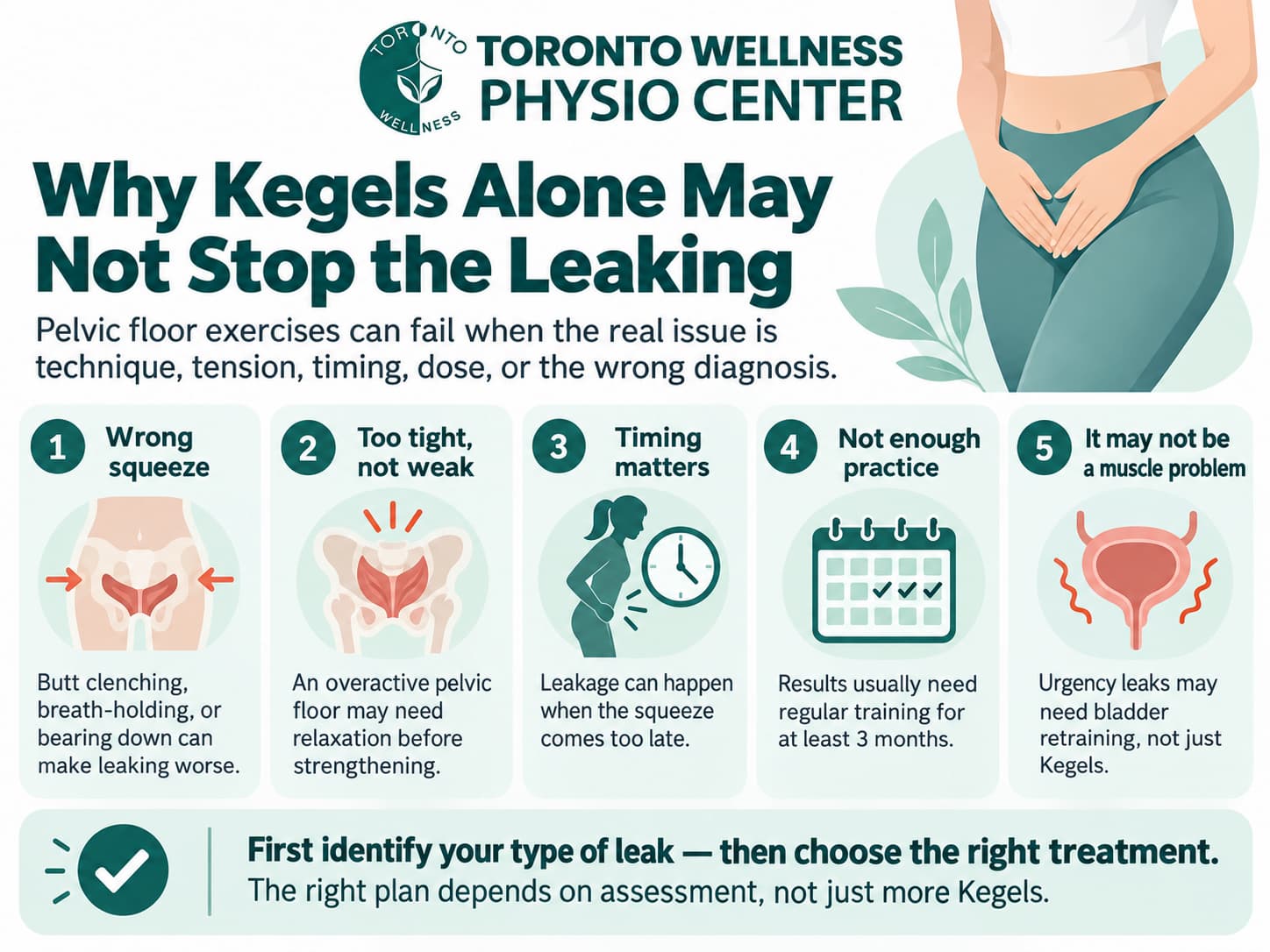
Why Kegels on their own often do not stop the leaking
Handing someone a leaflet is the default in a lot of healthcare systems, and it fails often enough that NICE wrote it into a national quality standard: many women who end up in specialist care have spent years doing pelvic floor exercises incorrectly, with nothing to show for it [+]. In clinic, the reasons fall into five groups.
- You may be squeezing the wrong way: Clenching your buttocks, holding your breath or, worst of all, bearing down (pushing, as you would on the toilet) all feel like effort. Bearing down increases pressure on the bladder, which is the opposite of what you want. You cannot see your pelvic floor, so without feedback there is no way to know.
- Your muscles may already be too tight: An overactive pelvic floor is tense most of the day. It feels weak because a muscle that never relaxes has nowhere left to contract to. Adding more squeezing can make urgency, frequency and pelvic pain worse. These people need to learn to let go before they train strength.
- Strength is not timing: A sneeze loads your bladder in a fraction of a second. Plenty of people have decent strength and still leak because the contraction arrives after the pressure. Learning to tighten just before a cough or a lift, a technique often called “the Knack”, is a separate skill from holding a squeeze.
- The dose was too small or stopped too soon: A few squeezes when you remember, for three weeks, will not change muscle. Guidelines use a minimum of eight contractions three times a day, sustained over at least three months.
- Your leak may not be a muscle problem: If you leak because the urge arrives suddenly and overwhelms you, the main lever is retraining the bladder, not the muscle.
Each of those failure points lines up with a different kind of leak. That is why naming yours comes before any exercise.
What therapy does for each type of leak
Physiotherapists sort urinary incontinence by what triggers it. Most people fit one type, and a large group have two at once.
Stress incontinence: leaking when you cough, sneeze, laugh, jump or lift
This is a closure problem. The urethra is not held shut firmly or quickly enough when abdominal pressure spikes. Treatment builds three things in order: a correct contraction, then endurance (holds of up to about ten seconds), then speed (quick, hard squeezes). The Knack gets layered in early because it can reduce leaks within weeks, well before strength changes. If you run or lift, the programme ends with graded return to impact.
This is also where the evidence is strongest. In a Cochrane review led by researchers at the Université de Montréal, 56% of women with stress incontinence reported being cured after pelvic floor muscle training, against 6% in untreated comparison groups [+].
Urge incontinence: a sudden need to go and not making it in time
Here the bladder signals “now” before it is full. The core treatment is bladder training: you learn to suppress an urge (stand still, do a few quick pelvic floor squeezes, breathe out slowly, wait for the wave to pass, then walk calmly), and you gradually stretch the time between trips. NICE recommends at least six weeks of bladder training as the first-line treatment for urge and mixed incontinence, and supervised pelvic floor training for at least three months for stress and mixed incontinence [+].
Expect your physiotherapist to ask about caffeine, fizzy drinks and how much you drink in the evening. If bladder training helps but frequency is still a nuisance, your doctor may add medication alongside it.
Mixed incontinence: both
Most mixed cases have one side that bothers you more. Treatment usually starts there, then runs muscle training and bladder training together. Tell your physiotherapist which leak actually changes your day, because that sets the priority more than the exam does.
Leaking after prostate surgery
Men leak after prostatectomy because the surgery changes how the urethra is closed off, which leaves the pelvic floor doing more of the work. Training often starts before the operation. Recovery follows its own timeline, covered in our guide to physiotherapy after prostatectomy; if this is you, bring your surgery date and your surgeon’s instructions to the first visit.
Leaks physiotherapy is not the first answer for
- Constant dribbling with a weak stream, or a feeling that you never finish emptying. This can mean urine is being retained, which needs a doctor first.
- Leaking because you cannot physically reach the toilet in time, from arthritis or poor mobility. Physiotherapy can help you move faster, but the bladder itself may be fine.
- Leaking that started at the same time as burning or a fever. Treat the infection first, then see whether the leak remains.
Knowing your type tells you what treatment should look like. Knowing whether anything else is going on tells you how fast to act.
When to see a doctor before a physiotherapist
Most bladder leaking is not dangerous, and most people can book a physiotherapy assessment directly. A few combinations change the order.
| What you notice | What to do |
|---|---|
| New leaking or trouble passing urine with numbness between your legs, new leg weakness or new severe back pain | Emergency department now |
| You cannot pass urine at all and your lower belly is painful or swollen | Emergency department now |
| Visible blood in your urine | See your doctor within a few days |
| Burning, fever, cloudy or strong-smelling urine with new leaking | Doctor or walk-in clinic the same week |
| Leaking plus a bulge, dragging or heaviness in the vagina | Book a pelvic floor assessment and mention the bulge |
| Leaking for weeks or months with none of the above | Book pelvic floor physiotherapy directly |
The first row matters most. UK primary care guidance treats these symptoms, on their own, as grounds for emergency imaging, even before any abnormal sign shows up on examination [+].
Once the red flags are ruled out, the real decision is usually between this therapy and something else.
Pelvic floor therapy compared with your other options
- Exercising from an app or leaflet: Cheap and sometimes enough, particularly if you already contract correctly. Nobody checks your technique, though, and nobody notices if your muscles are overtight.
- Pads: They manage leaks and treat nothing. Useful while you train; a poor long-term plan if you are in your thirties or forties.
- A pessary: A removable silicone device placed in the vagina that supports the urethra during activity. It suits women whose stress leaks happen mainly during exercise, and it can be combined with training.
- Medication for overactive bladder: Prescribed by your doctor, usually after bladder training has been tried and frequency is still a problem.
- Surgery: An option for stress incontinence that supervised conservative care has not controlled. Guidelines place a proper trial of pelvic floor training first because a meaningful share of people never need the operation.
Pelvic floor therapy is a poor fit if you cannot commit about three months, if your leak comes from retention or a neurological condition that needs medical workup, or if you want a result within a fortnight. Honest expectations at the start keep people from quitting at week five, just before the change usually shows.
What happens at pelvic floor physiotherapy
The first visit is mostly talking. Expect questions about when you leak, how often, what you drink, your bowels, pregnancies, surgeries and medications. If you filled in a bladder diary, it gets read line by line.
The examination usually includes an internal check, vaginal or rectal, because it is the only direct way to feel whether the muscle contracts, relaxes and holds. NICE advises confirming the contraction this way before supervised training begins. It is always optional. If you decline, your physiotherapist can work from external palpation, observation and your symptoms, and some clinics use ultrasound. You can pause or stop the exam at any point, and you can bring someone with you.
You leave the first visit with a home programme: specific holds, repetitions and positions, plus bladder habits if urgency is part of the picture. Follow-up visits progress the programme and recheck technique. Plan for at least three months before judging the result, with a review around six weeks to adjust. Progress looks like fewer pads, longer gaps between trips and fewer leaks in your diary, usually in that order.
The week before that first visit is not wasted time. A few things you do now will make the assessment sharper.
What you can do before your first appointment
- Keep a three-day bladder diary: Write down each time you pass urine, roughly how much (a measuring jug in the bathroom works), each leak and what triggered it, how strong the urge was from 0 to 3, and everything you drink. Three days is enough to show a pattern.
- Do not cut your fluids hard: Concentrated urine irritates the bladder and can make urgency worse. Aim for pale yellow urine through the day, and taper drinks in the two hours before bed if you get up at night.
- Trial less caffeine for two weeks: Coffee, tea, cola and energy drinks all count. Note any change in the diary rather than guessing.
- Stop stopping your stream: Halting urine midway can help you find the muscles once. Doing it as a daily exercise can interfere with normal emptying.
- Deal with constipation: Straining loads the pelvic floor from above every day. More fibre, fluids and a footstool under your feet on the toilet all reduce it.
- If you want to start squeezing now, keep it modest: Try eight gentle contractions, holding each for a few seconds, three times a day, lying down. Stop if it causes pain or if your leaking or urgency gets worse, and let your physiotherapist check your technique before you build on it.
Practical questions about cost and access decide whether a lot of people book at all, so they are worth answering directly.
Referral, cost and coverage in Ontario
You do not need a doctor’s referral to see a physiotherapist privately in Ontario. Some extended health plans ask for a doctor’s note before they reimburse, so check your plan before the first visit.
Most workplace extended health benefits include physiotherapy, usually as a yearly dollar amount. OHIP pays for physiotherapy only at designated community clinics, and only for certain groups: people 65 and over, 19 and under, those recently discharged from hospital, and people receiving Ontario Works or ODSP [+]. Those clinics often have waiting lists and may not offer internal pelvic floor assessment, so ask before you join one.
The number of sessions depends on your type of leak and how quickly your technique settles. Budget for a three-month course with visits spaced out as the home programme takes over.
All of that points to a short list of next steps.
What to do next
- Check the table above. If any of the first four rows match, see a doctor first.
- Start your three-day bladder diary this week.
- Book a pelvic floor physiotherapy assessment and bring the diary.
- Commit to twelve weeks, with an honest review at six.
A note before you act on this
This article is general information, not a diagnosis. Two people who describe their leaking in exactly the same words can have different problems once someone examines them, and the programme that fixes one can make the other worse. A proper assessment is the fastest route to the right plan. You can book with a clinician through Physiotherapy in Richmond Hill or Physiotherapy in North York. If you have new leaking with numbness between your legs, leg weakness or an inability to pass urine, go to the emergency department.
FAQ
Does pelvic floor therapy work for urinary incontinence? Yes, for most people with stress, urge or mixed leaking. The evidence is strongest for stress incontinence, where more than half of women in trials reported being cured after supervised pelvic floor muscle training, compared with a small minority who had no treatment.
How long does pelvic floor therapy take to work? Plan for at least three months. Some people notice fewer leaks within a few weeks once they learn to tighten before a cough or sneeze, but muscle change takes longer, and guidelines use three months as the minimum trial.
Do I have to have an internal exam? No. An internal exam gives the most accurate picture of how your muscles contract and relax, but it is always your choice. Your physiotherapist can assess you externally and adjust the programme to what they can see and feel.
Can pelvic floor therapy help urge incontinence? Yes. For urge leaking, the main treatment is bladder training: learning to calm a sudden urge and gradually lengthening the time between trips. Guidelines recommend at least six weeks as the first-line approach.
Is it too late if my leaking started years ago or after menopause? No. Age and the length of time you have leaked do not rule you out. Trials of pelvic floor training include older women, and the assessment will show what your muscles can still do.
Do I need a referral in Ontario? Not for private physiotherapy. Your extended health plan may want a doctor’s note before reimbursing, and OHIP-funded community clinics require a referral and have eligibility rules.