
If you are asking why is my urine flow slow, and you are a woman, the answer usually sits in one of three places: the bladder muscle is not squeezing hard enough, the pelvic floor muscles are not letting go, or something is bending or narrowing the urethra, most often a prolapse. Infections, medications and constipation can do the same thing for a while and then settle.
A slow stream in women is common, and most causes are treatable. It is also a symptom that men and women experience for quite different reasons, which is why advice written with a prostate in mind often does not fit.
One exception before anything else. If you cannot pass urine at all and your lower belly is full and painful, go to the emergency department now. Do the same if a slow or stopped stream comes with new numbness around the genitals or inner thighs, new loss of bowel control, or weakness in the legs.
Our pelvic floor physiotherapy for slow stream and incomplete emptying checks whether your pelvic floor is too tight, too weak or both, before any exercise is prescribed. No referral is needed to book.
“Slow” is a word people use for several different things, and only some of them are a problem.
What a slow urine stream is, and what it is not
Clinicians measure the stream as a flow rate, in millilitres per second. For most women it is high, above 15 to 20 mL per second, but the reading only means something when at least 150 mL is passed [+]. That second number matters more than people expect.
A weak stream usually travels with one or more of these:
- Hesitancy: Waiting at the toilet before anything starts.
- Intermittency: A stream that stops and starts.
- Straining: Pushing with your belly to get it going or keep it going.
- Incomplete emptying: The sense that you have not finished, or needing to go again a few minutes later.
- Dribbling: A trickle after you stand up.
What it usually is not:
- Not a problem when the bladder was nearly empty: A small volume comes out slowly. If you go “just in case” every hour, a weak stream is expected.
- Not the same as urgency or frequency on their own: Rushing to the toilet is a storage problem. A slow stream is an emptying problem, though the two often overlap.
- Not a diagnosis: A slow stream tells you emptying is harder than it should be. It does not tell you why.
That last point is where most online advice goes wrong.
Why a slow stream happens in women
Emptying the bladder needs two things to happen at once. The bladder wall (the detrusor muscle) contracts, and the pelvic floor and urethral sphincter relax so the urine has a clear path. A slow stream means one side of that is not working: the squeeze is weak, or the outlet is not opening.
In men the outlet problem is usually the prostate. Women have no prostate, so an underactive bladder plays a bigger part. In a study of almost 2,000 women having bladder pressure tests at a urogynaecology clinic, about a third met common definitions of an underactive bladder, and being 65 or older roughly doubled the odds [+].
The complication is that a weak squeeze and a blocked outlet produce the same slow stream. A flow rate alone cannot tell them apart [+], and the right treatment for one can be the wrong treatment for the other.
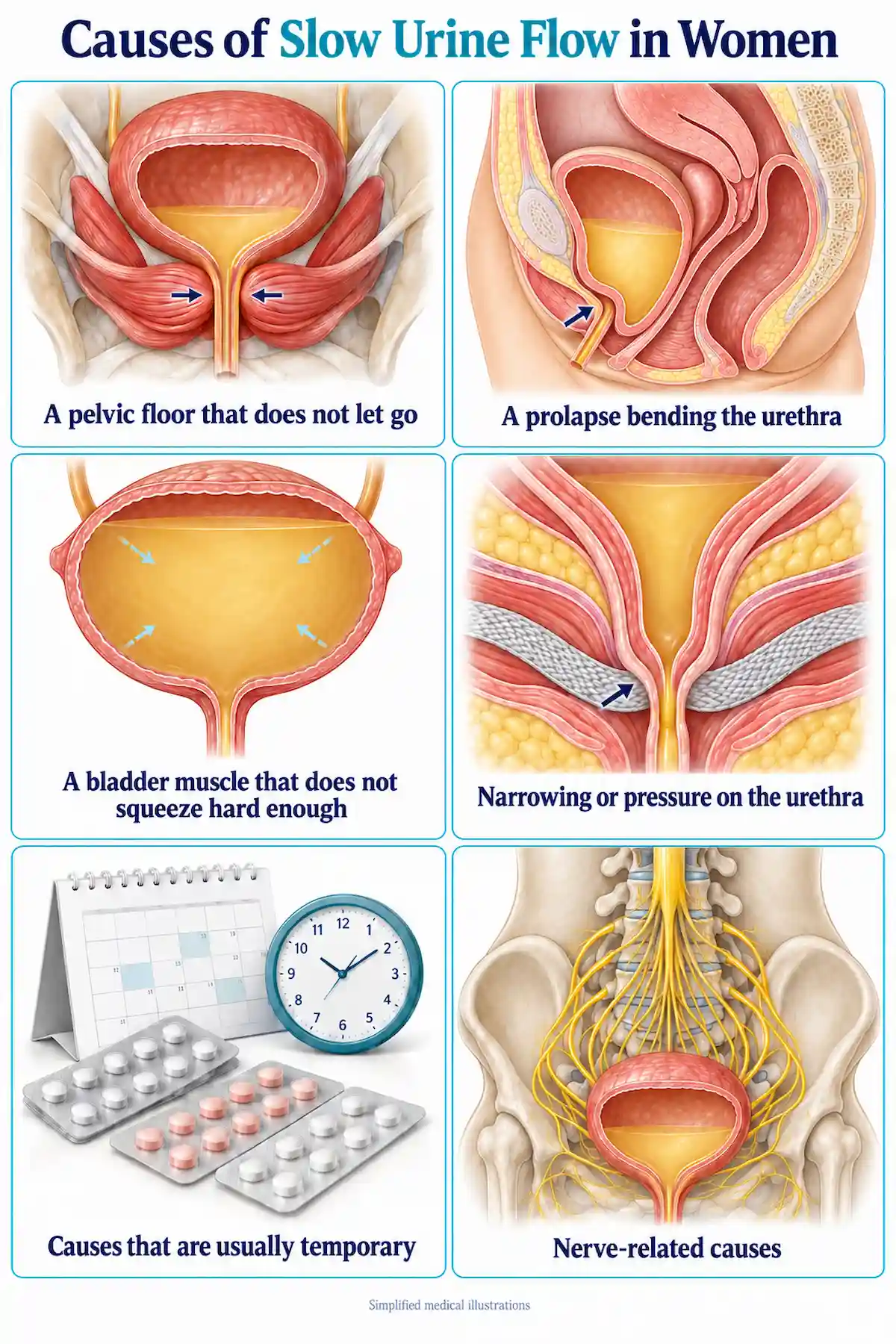
Causes of slow urine flow in women, grouped by where they come from
A pelvic floor that does not let go
- The muscles around the urethra stay partly switched on while you try to pass urine, so the stream starts slowly, stops and starts, or never fully empties
- Often learned: hovering over public toilets, rushing, pushing to finish faster, holding on for long stretches at work
- Common alongside constipation and straining for bowel movements
- Often comes with pelvic pain, pain with sex, or a feeling of tightness or burning after voiding
- Stress and anxiety tend to make it worse, because the pelvic floor tightens with the rest of the body
Clinicians call this pattern dysfunctional voiding. It is one of the most treatable causes on this list, and it is also the one most likely to be made worse by the wrong exercises.
A prolapse bending the urethra
- A bladder that drops into the front wall of the vagina (a cystocele) can kink the urethra like a bent garden hose
- Typical extras: heaviness or a bulge in the vagina, worse at the end of the day or after standing and lifting
- Some women find they need to press on the bulge, or lean far forward, to empty
- Larger prolapses cause this far more often than small ones
In a study of 60 women with prolapse, outlet obstruction was uncommon with mild bladder prolapse and common with large ones, and supporting the prolapse with a pessary during testing restored normal flow in almost all of the obstructed women [+]. That is why prolapse support, whether through pelvic floor training, a pessary or surgery, can improve emptying.
A bladder muscle that does not squeeze hard enough
- More common with age, particularly after 65
- Linked to diabetes and other conditions that affect the nerves to the bladder
- Can follow years of holding on for long periods, which overstretches the bladder wall
- Often shows up as needing to strain, or as a stream that fades and needs a second attempt
Narrowing or pressure on the urethra
- After surgery for stress incontinence (a sling or bladder neck repair), if the support is tighter than intended
- Scarring that narrows the urethra (urethral stricture), which is uncommon in women
- Pressure from a large fibroid or another pelvic mass
- In early pregnancy, a tilted womb can occasionally press on the bladder outlet
Causes that are usually temporary
- Urinary tract infection: Burning and frequency, sometimes with a stream that is slow and painful to pass.
- Medications: Anticholinergics (some bladder, allergy and nausea medicines), antihistamines, opioid painkillers, some antidepressants, decongestants such as pseudoephedrine and some muscle relaxants are all linked to difficulty passing urine [+].
- After childbirth: Swelling, an epidural, a long pushing stage or stitches can make the first days slow.
- After surgery or an anaesthetic: Especially pelvic, abdominal and spinal procedures.
- Constipation: A full rectum presses on the bladder outlet and makes the pelvic floor harder to relax.
- Vulval or vaginal irritation: Pain at the opening makes the pelvic floor guard.
Nerve-related causes
- Multiple sclerosis, Parkinson’s disease, stroke and spinal cord conditions
- Disc problems in the lower back, which only rarely affect the bladder
- Cauda equina syndrome: pressure on the nerves at the base of the spine, causing bladder changes together with numbness around the genitals and back passage. This is an emergency.
The categories tell you what might be going on. The more useful question is how fast you need to act.
How urgently to act on a slow stream
| What you notice | What it may mean | What to do |
|---|---|---|
| Cannot pass urine at all, with a full, painful lower belly | Acute urinary retention | Emergency department now |
| Slow or stopped stream with new numbness around the genitals, inner thighs or back passage, new bowel accidents, or leg weakness | Possible cauda equina syndrome or another nerve emergency | Emergency department now |
| Burning, fever, back or side pain, or blood in the urine | Possible infection | See your doctor or a walk-in clinic the same day |
| Started within days of a new medication, surgery or giving birth | Medication effect or temporary retention | Call your pharmacist, surgeon, midwife or doctor the same day |
| Leaking small amounts often, with a weak stream and a bladder that never feels empty | Possible overflow incontinence | See your doctor within a week for a urine test and a bladder scan |
| A bulge or heaviness in the vagina, with harder emptying | Likely prolapse | Book a doctor’s visit or pelvic floor physiotherapy assessment |
| Slow start, stop-start stream, straining or pelvic tightness for weeks or months | Likely pelvic floor overactivity or an underactive bladder | Book a pelvic floor physiotherapy assessment |
Most women reading this fit one of the last three rows. Those are worth acting on, but they are not emergencies.
The row about leaking deserves a second look, because it is the one most often misread.
Slow stream and leaking: why they can be the same problem
It seems backwards, but a bladder that does not empty properly can leak. When urine is left behind after each visit, the bladder stays close to full, and small amounts spill out through the day without much warning. This is overflow incontinence, and it is treated very differently from leaking when you cough or sneeze. Our page on urinary incontinence types and treatment explains how the five types differ.
The practical point: if you leak and also have a weak stream, do not start a standard leak-prevention program on your own. Get checked first.
The same caution applies to the most common piece of advice women hear.
Tight or weak pelvic floor: why Kegels are not for everyone
A pelvic floor that does not relax: Slow start, stop-start stream, a feeling of not finishing, often with constipation, pelvic or vaginal pain, or pain with sex. Here the muscles need to learn to release. Kegels (squeezing exercises) add more tension and can make emptying harder.
A weak or poorly supported pelvic floor: Leaking with coughing, sneezing or running, a bulge or heaviness, a stream that is slow only when a prolapse is down. Here strengthening is often part of the answer, sometimes with a pessary.
Both at once: More common than people assume, particularly after childbirth or years of straining. Some muscles are overworking while the overall system is weak.
From the outside, these can look the same. Telling them apart is usually done by assessment, which is the next step.
What happens when you get it checked
You will usually need both a doctor and a pelvic floor physiotherapist, and the order depends on your symptoms.
Your family doctor or a walk-in clinic can:
- Test your urine for infection
- Review your medications
- Arrange a bladder scan after you void (post-void residual), which shows how much urine is left behind
- Refer you to a urologist or urogynaecologist for a flow test or bladder pressure tests (urodynamics) if the cause is unclear
A pelvic floor physiotherapist will:
- Ask about your bladder, bowel, pregnancies, surgeries and pain
- Usually give you a 3-day bladder diary to fill in
- Check your posture, breathing and abdominal pressure
- Assess whether the pelvic floor contracts, relaxes and lets go fully. An internal assessment is often the most accurate way to do this, but it is always optional and only done with your consent
- Use biofeedback, if useful, so you can see on a screen when the muscles are switching off
Treatment for a pelvic floor that does not relax is down-training: breathing, positioning and biofeedback to teach the muscles to release on cue, and only later any strengthening. In a small study of 31 women with dysfunctional voiding, about four in five improved after six biofeedback sessions with a physiotherapist over three months plus a daily home program [+]. The study had no control group, so treat the number as encouraging rather than definitive.
In Ontario you can book a pelvic floor physiotherapist directly, without a referral, although some extended health plans ask for one before they reimburse. Physiotherapists cannot order a bladder scan, so if one is needed, your physiotherapist will send you to your doctor with a summary.
What you can do while you wait
These are safe for most women with a slow stream that is not an emergency. They are about removing the habits that make emptying harder, not treating a diagnosis you have not had yet.
- Sit down fully: No hovering. Hovering keeps the pelvic floor and thigh muscles working at the exact moment they need to let go. Use a seat cover or wipe the seat instead.
- Support your feet and lean forward: Feet flat, or on a small step if your feet do not reach the floor comfortably, with forearms resting on your thighs.
- Breathe, do not push: Take 3 to 5 slow breaths into your belly before you start, and let the stream come. Straining tightens the pelvic floor rather than opening it.
- Give it time: Stay seated until the stream has fully finished, then wait 20 to 30 seconds, rock gently forward and try once more. This is called double voiding.
- Go every 3 to 4 hours while awake: Not every hour “just in case”, and not holding for 6 hours at work.
- Keep fluids steady: Spread your drinks through the day rather than drinking very little to avoid trips. Concentrated urine irritates the bladder.
- Treat constipation: Fibre, fluids and the same no-straining rule for bowel movements.
- Check your medicines: Ask your pharmacist whether anything you take, including over-the-counter allergy and cold remedies, can affect your bladder. Do not stop a prescribed medicine on your own.
- Hold off on Kegels: Until someone has checked whether your pelvic floor is tight or weak.
If these changes make a clear difference within two or three weeks, that is useful information to bring to your assessment.
Does a slow stream go away on its own?
Sometimes. A stream that slowed after a new medication, a urinary tract infection, childbirth or surgery often recovers within days to weeks once the cause settles. If it does not, or if it came on gradually over months, it rarely fixes itself without some change in habits, treatment or both.
Age and menopause make a slow stream more likely, but neither makes it something you have to accept. An underactive bladder, a pelvic floor that does not relax and a prolapse all have treatments, and the earlier the pattern is identified, the easier it usually is to change.
What to do next
If none of the emergency signs apply, start with the simple version: get a urine test and ideally a bladder scan from your doctor, and book a pelvic floor physiotherapy assessment to find out whether your pelvic floor needs to relax, strengthen or both. If you leak as well as having a slow stream, mention both, because the combination changes the plan.
If any emergency sign applies, skip all of this and go to the emergency department.
Frequently asked questions
Is it normal for a woman’s urine stream to get weaker with age?
It is common, mainly because the bladder muscle tends to squeeze less strongly after 65 and prolapse becomes more frequent. Common is not the same as untreatable, so a change you have noticed is still worth checking.
Can a tight pelvic floor cause a slow urine stream?
Yes. If the pelvic floor muscles do not fully relax while you pass urine, the stream can be slow to start, stop and start, or leave you feeling you have not finished. This usually improves with relaxation training rather than strengthening.
Can a prolapse cause a weak urine stream?
Yes. A bladder that drops into the vaginal wall can kink the urethra, particularly when the prolapse is large. Many women notice they empty better lying down, in the morning or when they press on the bulge.
Should I do Kegels if my urine flow is slow?
Not until your pelvic floor has been assessed. If the slow stream comes from muscles that do not relax, Kegels add tension and can make emptying harder. If it comes from weakness or prolapse, strengthening may help.
When is a slow urine stream an emergency?
When you cannot pass urine at all and your lower belly is full and painful, or when a change in your stream comes with numbness around the genitals or inner thighs, loss of bowel control or leg weakness. Go to the emergency department.
Can medication make it hard to pee?
Yes. Some antihistamines, opioid painkillers, antidepressants, decongestants, muscle relaxants and bladder medicines can slow the stream or cause retention. Ask your pharmacist, and do not stop a prescribed medicine without advice.
Before you act on any of this
This article explains the common reasons a woman’s stream slows down; it cannot tell you which one applies to you. A pelvic floor that will not let go, a prolapse and a bladder that squeezes weakly can feel almost identical from the toilet seat, yet the right exercise for one can make another worse. An assessment that checks your emptying and your pelvic floor together is the fastest way to a plan that actually fits. You can book an assessment for physiotherapy in Richmond Hill or physiotherapy in North York. If you cannot pass urine at all, or have new numbness around the genitals with bladder changes, go to the emergency department instead.