
No. Shockwave therapy is not covered by OHIP when you have it at a private physiotherapy, chiropractic or foot clinic, which is where almost all of it is delivered in Ontario. Most people pay for it through extended health benefits, where it is claimed under the practitioner who treats you (usually physiotherapy, chiropractic or chiropody), or through a car accident or WSIB claim.
So the useful question is not whether OHIP pays. It is which line of your plan the treatment will be billed under, how much of that line is left this year, and whether shockwave is worth a full course for your condition at all.
This guide answers all three, with the questions to put to your insurer before you book.
Part of the confusion is that “shockwave” and “OHIP” each mean more than one thing. Pinning both down first saves a wasted phone call.
What “covered by OHIP” means for shockwave therapy
OHIP pays for insured doctor and hospital services. Outside hospital, its only route to physiotherapy is a separate government-funded program at enrolled community clinics, covered in the next section. A visit to a private clinic for shockwave is neither of these, so there is nothing for OHIP to pay.
The shockwave this article is about is extracorporeal shockwave therapy (ESWT): a hand-held device that delivers pressure waves through the skin into a sore tendon, fascia or bone. It is used mainly for long-standing tendon and heel problems that have not settled with exercise.
What it is not:
- Not lithotripsy: Shockwave lithotripsy breaks up kidney stones. It is a hospital procedure arranged by a urologist, and nothing about it applies to tendon treatment at a clinic.
- Not shockwave for erectile dysfunction: Low-intensity shockwave for ED uses different settings, is sold through private men’s health clinics, and is outside the scope of this guide.
- Not a funded-program service by default: Being eligible for government-funded physiotherapy does not mean shockwave is included, for reasons explained next.
If you are 65 or older, under 20 or recently out of hospital, the funded program is the obvious next thing to ask about. It rarely solves the shockwave question.
Why the government-funded physiotherapy program usually will not pay for it either
Ontario funds physiotherapy at no cost for people with a valid health card who are 65 or older, 19 or under, recently discharged after an overnight hospital stay or day surgery in the last 12 months, or receiving Ontario Works or ODSP [+]. Since June 2024 you no longer need a referral from your family doctor to be seen, although eligibility is still checked by the clinic [+].
The program pays clinics for an episode of physiotherapy care. It does not name treatments or machines, and the province’s own program page lists none. In practice, clinics enrolled in the program usually offer shockwave, if they offer it at all, as a separately paid service alongside their funded care. If you qualify for the program, ask the clinic directly whether shockwave is part of your funded treatment or an extra charge, before your first session rather than after it.
That leaves the routes that do pay, and there are more of them than most people expect.
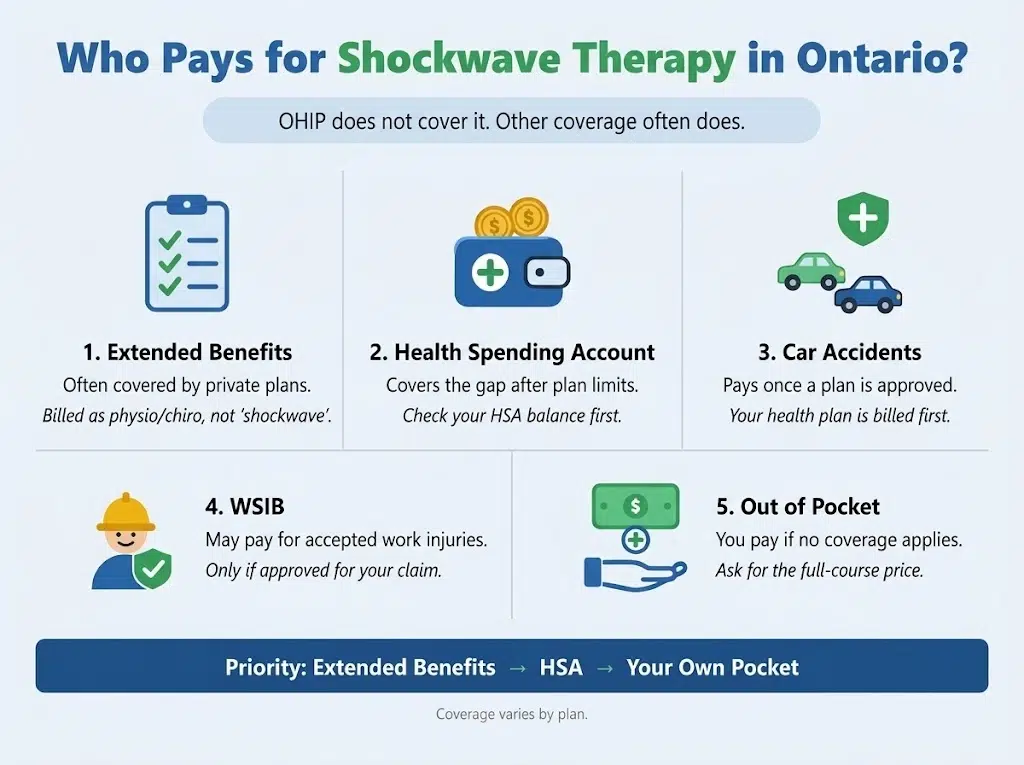
Who pays for shockwave therapy in Ontario
Extended health benefits
- Shockwave is not usually listed as a benefit in its own right. It is claimed under the practitioner who delivers it: physiotherapy, chiropractic, or chiropody and podiatry for foot conditions.
- That category’s percentage and yearly maximum then apply, exactly as they would to any other visit with that practitioner. Your booklet is the only reliable source for both numbers.
- Some plans pool physiotherapy, chiropractic and massage into one shared yearly amount, so a course of shockwave can use up money you were counting on for something else.
- Some plans only reimburse treatment delivered directly by the registered practitioner, not by an assistant working under supervision [+]. Ask who will hold the device.
- A few plans want a doctor’s note before they reimburse paramedical treatment. Check before, not after.
Health spending account
- If your employer gives you a health spending account, treatment by a regulated practitioner can usually be claimed from it once your regular benefits run out.
- It is the most common way people cover the gap between what the plan pays and the full fee.
Car accident claims
- If the tendon or heel problem came from a car accident, your auto insurer’s accident benefits can pay for treatment once a treatment plan is approved. Our motor vehicle accident program handles that paperwork.
- Any extended health plan you hold is normally billed first, with the auto insurer covering the rest.
WSIB
- For an accepted work injury, WSIB can pay for physiotherapy. Whether shockwave is included depends on the treatment WSIB approves for your claim, so ask your case manager or the clinic before you start.
Paying yourself
- Ask for the price of one session and the price of the full planned course. A course is usually three to five sessions, so the single-session price is the wrong number to budget with.
- Keep every receipt. Treatment from a regulated practitioner generally counts toward the federal medical expense tax credit, including the share your plan did not pay.
In practice, nearly everyone ends up on one of these routes, sometimes two. The table below matches each situation to its first move.
Is shockwave therapy covered by insurance in your situation?
| Your situation | Who is likely to pay | What to do this week |
|---|---|---|
| You have a group or individual health plan | Your plan, under physiotherapy, chiropractic or chiropody | Find that line in your booklet: percentage, yearly maximum, whether it is shared, whether a doctor’s note is needed |
| Your plan maximum is used up, but you have a health spending account | The spending account | Check the balance and whether claims go through the same insurer |
| You are 65+, 19 or under, or just out of hospital, with no private plan | Probably nobody for shockwave itself | Ask a funded clinic whether shockwave is included or extra; start the funded exercise program either way |
| The problem started in a car accident | Your auto insurer, after your health plan | Report the claim and bring the claim number to your first visit |
| The problem started at work | WSIB, if approved for your claim | Ask your case manager whether shockwave is part of the approved treatment |
| No coverage at all | You, with the tax credit | Get the full-course price before committing, and keep receipts |
| Heel or calf pain began with a sudden pop, and you cannot rise onto your toes | Nobody should be paying for shockwave yet | Go to the emergency department or urgent care the same day: that can be a torn Achilles tendon |
If two rows fit, use them in order: the plan first, then the spending account, then your own money.
Knowing who pays is half the decision. The other half is whether a course is worth paying for at all.
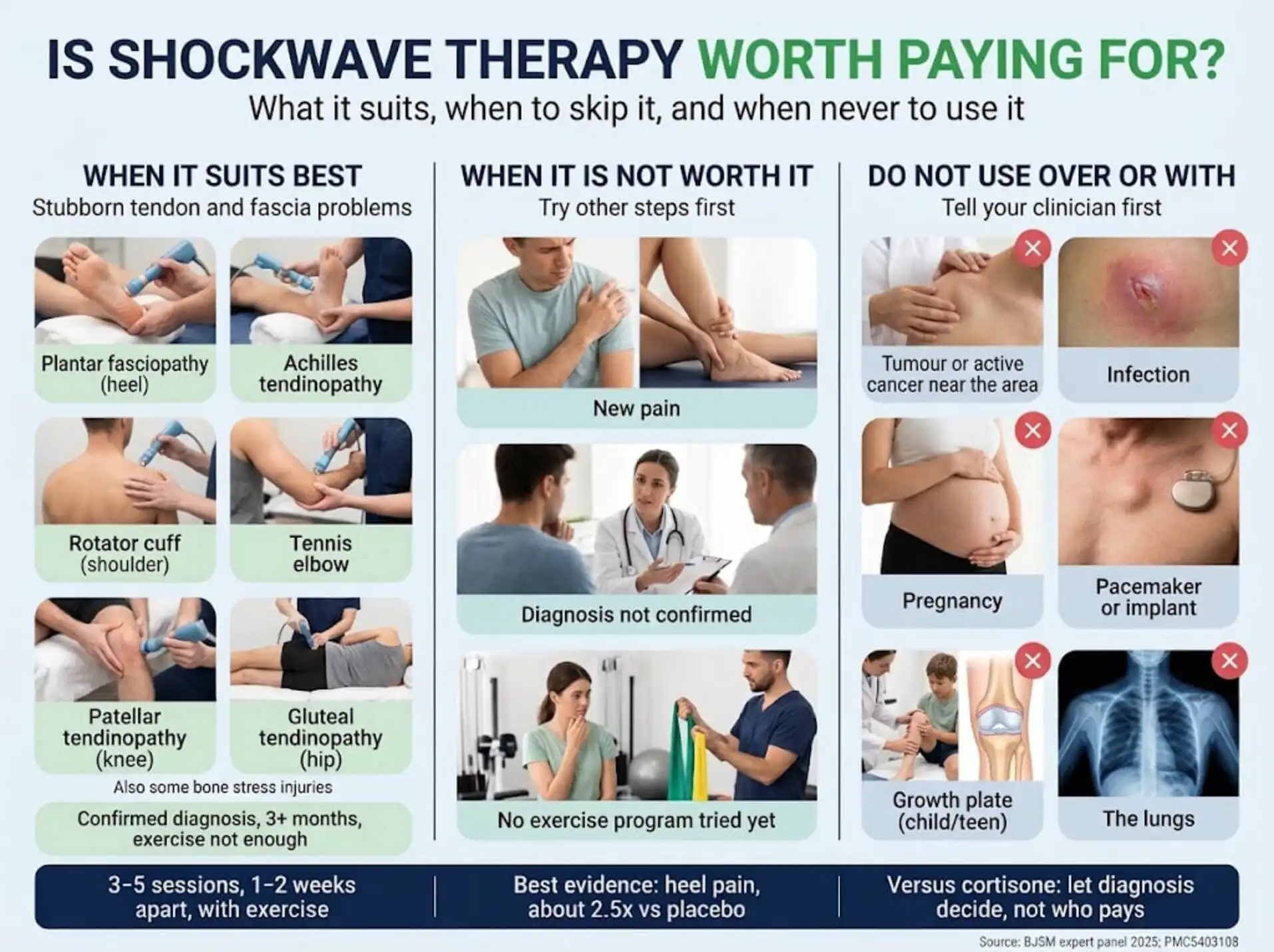
Is shockwave worth paying for? What it suits and what it does not
Shockwave works best on a short list of stubborn tendon and fascia problems, and much less well outside it. An international expert panel published in 2025 agreed on its use for conditions including plantar fasciopathy, Achilles tendinopathy, calcific and non-calcific rotator cuff tendinopathy, tennis elbow, patellar tendinopathy, gluteal tendinopathy and some bone stress injuries, typically over three to five sessions one to two weeks apart, and as one part of care alongside exercise, not as a replacement for it [+]. The same panel noted that the research behind each condition is uneven, which matters when you are paying out of pocket.
Chronic plantar fasciitis (heel pain) has some of the better evidence. A meta-analysis of nine randomised trials and 935 patients found that people treated with shockwave were about two and a half times more likely to have a successful outcome than those given a placebo treatment [+]. Our heel and foot pain treatment uses it for exactly that group, once a few months of exercise have not been enough.
Shockwave tends to be worth it when: The problem is a confirmed tendinopathy or plantar fasciitis, it has lasted three months or more, and you have already done a well-dosed exercise program without enough improvement.
It tends not to be worth it when: The pain is new, nobody has confirmed the diagnosis, or you have not tried a loading program yet. Exercise is billed to the same benefit and often solves the problem for less.
It should not be used at all over: A tumour or active cancer near the area, an infection, a pregnancy, a pacemaker or other implanted device, a growth plate in a child or teenager, or the lungs, according to the same expert panel’s list of contraindications [+]. Tell your clinician about any of these before treatment.
The comparison people make most often is with a cortisone injection. A cortisone injection from a doctor is a physician service, so the doctor’s part is billed to OHIP rather than to your benefits. That is a real difference in cost, but repeated injections into tendons carry their own risks, and the choice between them should rest on your diagnosis rather than on who pays.
What happens at a shockwave assessment, including the billing
Your first visit is an assessment, not a shockwave session booked blind. Expect your physiotherapist or chiropractor to:
- Confirm the diagnosis with a history and hands-on tests, and rule out the problems shockwave does not treat
- Screen for the contraindications above and check your medications, including blood thinners
- Explain how many sessions to expect and when progress will be reviewed (we review at 8 to 12 weeks, because tendons keep responding after the last session)
- Give you an exercise program, which does most of the long-term work
- Confirm with your insurer which category the treatment bills under, and what you will owe
Your receipt names the practitioner who treated you and describes the service. That matters if your insurer ever audits the claim, and it is the reason the same practitioner usually delivers every session.
How to check your plan before you book
Insurers answer coverage questions literally, so the wording of the question matters. “Do you cover shockwave?” can get a no from a call centre, even on a plan that pays for it when a physiotherapist bills it as treatment. Ask these instead:
- Is shockwave therapy claimable when a registered physiotherapist (or chiropractor, or chiropodist) delivers it as part of treatment?
- Which practitioner category will it be paid under, and what percentage does that category pay?
- What is the yearly maximum for that category, and how much of it is left?
- Is that maximum shared with massage, chiropractic or other practitioners?
- Do you need a doctor’s note or referral before the plan reimburses?
- Will the plan pay if a physiotherapy assistant delivers part of the treatment?
Write the answers down with the date and the name of the person you spoke to. If the clinic bills your insurer directly, the front desk can usually check items 2 to 4 for you.
Making a small benefit cover a full course
Here is how the numbers usually go, using illustrative figures. Say your physiotherapy line pays 80% up to $500 a year, and you have already used $300 on regular visits since January. That leaves $200, enough for part of a three-session course, with the rest paid from a spending account or yourself.
A few ways to stretch it:
- Front-load the assessment: Confirm the diagnosis before committing to a course, so the benefit is not spent on a treatment that does not suit you.
- Use the year boundary: Plans usually reset in January or on your plan anniversary. A course started in late November can finish after the reset.
- Check a second plan: If you are covered under a spouse’s plan as well, the second plan can often pay part of what the first one leaves.
- Keep the home program going: The exercise program is what holds the improvement after the shockwave course ends, and it costs nothing once you have it.
If a claim is declined, ask the insurer for the reason in writing. A decline is often about the category billed, a missing referral or who delivered the treatment, all of which can sometimes be fixed and resubmitted.
What to do next
If you have a health plan, find the physiotherapy, chiropractic or chiropody line before booking, or let the clinic check it for you. If you qualify for the government-funded program, start there for your exercise care and ask whether shockwave is included or extra. And if your pain is recent or has never been diagnosed, the assessment comes first: shockwave is a treatment for specific, confirmed problems, and paying for it on a guess is the most expensive way to use it.
For what Blue Cross and other private plans pay at 65 and over, and when OHIP-funded physio is the better route, see our guide on whether Blue Cross covers physiotherapy for seniors. For how benefits are billed day to day, see our extended health care plan page.
Frequently asked questions
Does OHIP pay for shockwave therapy for plantar fasciitis?
No. Shockwave for plantar fasciitis is delivered at private physiotherapy, chiropractic and foot clinics, which OHIP does not pay for. Many extended health plans reimburse it under the practitioner who treats you, usually physiotherapy or chiropody.
Is shockwave therapy covered by extended health insurance?
Often, yes, when a registered practitioner delivers it as part of treatment. It is usually claimed under that practitioner’s category, such as physiotherapy or chiropractic, and counts toward that category’s yearly maximum. Check your booklet, because plans differ.
Can I get shockwave therapy through the government-funded physiotherapy program?
Sometimes, but do not assume it. The program funds physiotherapy care without naming specific treatments, and enrolled clinics often charge separately for shockwave. Ask the clinic before your first visit.
Do I need a doctor’s referral for shockwave therapy in Ontario?
Not to be treated. You can book a physiotherapist or chiropractor directly. Some insurance plans ask for a doctor’s note before they reimburse, so check yours before starting a course.
How many shockwave sessions will I need?
Most courses are three to five sessions, one to two weeks apart, with progress reviewed several weeks after the last one. Budget for the full course, not a single session.
Can I claim shockwave therapy on my taxes?
Generally yes, when a regulated practitioner such as a physiotherapist or chiropractor provides it. You can claim the part you paid yourself, including what your plan did not cover, as a medical expense. Keep your receipts.